
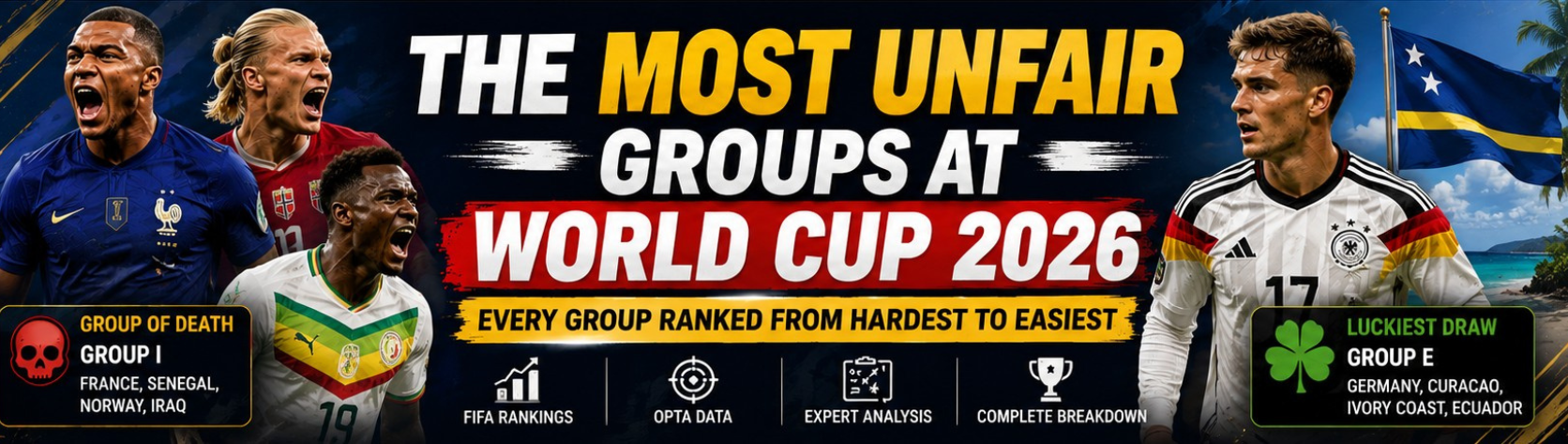
Not every group at the FIFA World Cup 2026 is equal. Not even close.
Look at the draw image and the reality hits you immediately. Group J contains Argentina — the defending world champions — alongside Algeria, Austria and Jordan. Meanwhile Group E contains Germany alongside Curacao — a nation of 156,000 people making their World Cup debut — Ecuador and Ivory Coast. One of these groups is a genuine test for the strongest team in it. The other is, on paper, one of the most imbalanced draws in World Cup history.
Published: June 6, 2026 | Author: Hemim SK
The 2026 World Cup expanded from 32 to 48 teams specifically to give more nations the opportunity to participate. But that expansion — and the seeding system FIFA used to create the draw — has produced twelve groups of wildly different difficulty. Some teams walked out of the draw ceremony knowing they had reached the knockout rounds. Others walked out knowing they face a battle for survival in every single match.
Using FIFA rankings, Opta Power Rankings data and match analysis, here is the definitive ranking of every World Cup 2026 group from hardest to easiest — and the full story of who got the luckiest and most unlucky draws of the entire tournament.
World Cup 2026 Groups — Key Facts
Total groups: 12
Teams per group: 4
Teams that advance: Top 2 from each group (plus 8 best third-place teams)
Highest average ranked group: Group I — France, Senegal, Norway, Iraq (Average FIFA ranking 25.75)
Lowest average ranked group: Group E — Germany, Curacao, Ivory Coast, Ecuador (Average FIFA ranking 39)
Luckiest draw: Germany — drew the group with the lowest average FIFA ranking
Unluckiest draw: France, Norway and Senegal — all three elite teams drawn into the same group
Biggest mismatch: Germany vs Curacao — ranked 9th vs 82nd in the world
THE GROUPS RANKED — HARDEST TO EASIEST
1. Group I — The Real Group of Death
Teams: France, Senegal, Norway, Iraq
Average FIFA ranking: 25.75 (highest of any group — meaning hardest)
France are one of the two or three favourites to win the entire tournament. Senegal are back-to-back Africa Cup of Nations champions with Premier League and Bundesliga quality throughout their squad. Norway — led by Erling Haaland, who scored twice against Sweden in their warm-up — are the most dangerous dark horse in the tournament. Iraq are World Cup debutants who just drew 1-1 with Spain in their pre-tournament friendly.
Three of the four teams in this group are realistically capable of reaching the knockout rounds. Only one of them — Iraq — has a significantly weaker profile than the others. France, Senegal and Norway would be strong enough to advance from almost any other group in the tournament. In Group I, at least one of them goes home in the group stage.
The Mbappe vs Haaland match — France vs Norway — is the most anticipated individual fixture of the entire group stage. It is scheduled at Gillette Stadium in Boston.
Who goes out: Senegal or Norway — one genuinely elite team is eliminated before the knockout rounds even begin. This is the greatest injustice of the entire draw.
Luckiest team in the group: Iraq. They face three world-class opponents but have nothing to lose and the surprise of the pre-tournament window behind them — their 1-1 draw with Spain showed they are not there just to participate.
2. Group F — The Hidden Group of Death
Teams: Netherlands, Japan, Sweden, Tunisia
Average FIFA ranking: 26
Every website calls Group I the Group of Death. Nobody is talking about Group F. They should be.
The Netherlands are a top-ten nation with Virgil van Dijk, Cody Gakpo and one of Europe’s most technically gifted squads. Japan have beaten Germany and Spain at the last two World Cups — not by luck, but through tactical sophistication and extraordinary collective discipline. Sweden — who narrowly missed qualification through the playoff — have Viktor Gykeres, who scored twice in their friendly against Greece and is one of the most lethal strikers in European football. Tunisia are organised, physical and difficult to beat.
The Opta Power Rankings actually rank Group F as the hardest group in the entire tournament when average rankings are considered — because the gap between the best and worst team is the smallest of any group. Netherlands, Japan, Sweden and Tunisia are all within a relatively narrow band of quality. Every match could go either way.
Japan are the danger team here. They have beaten Germany and Spain. They will back themselves against the Netherlands. And they are right to.
Who goes out: Tunisia are the most likely third or fourth-place finisher — but do not assume Japan make it through ahead of the Netherlands automatically. This group is genuinely too close to predict with confidence.
Luckiest team in the group: None of them got lucky. This is an honest, competitive group from top to bottom.
3. Group L — England’s Nightmare of History
Teams: England, Croatia, Ghana, Panama
Average FIFA ranking: 28
On paper Group L looks manageable for England. Croatia, Ghana and Panama are not in the same class as France, Argentina or Germany. England are the highest-ranked team in the group and should advance comfortably.
History says otherwise.
England vs Croatia carries specific, painful historical weight. Croatia beat England in the semi-finals of the 2018 World Cup — a match England led with minutes to go before Mario Mandzukic broke their hearts in extra time. The Croatian golden generation may have faded — their 0-2 loss to Belgium in pre-tournament confirmed that concern — but the memory of 2018 will be in every English player’s mind from the first whistle.
Ghana have proven in this pre-tournament window that they are genuinely dangerous — their 1-1 draw with Wales showed quality throughout the squad. Panama are physical, organised and never easy to beat.
England should advance. History and talent suggest they will. But Group L is not the straightforward passage it appears on paper — and England have a remarkable talent for making simple things complicated at major tournaments.
Who goes out: Panama and most likely Croatia — but Ghana could cause a significant upset if England are not focused from the first minute of their opening match.
Luckiest team in the group: Panama — they face England, Croatia and Ghana, all of whom are better than them on paper. But Panama drew 2-0 against Dominican Republic in their warm-up and look organised. Getting a point from this group would be a major achievement for them.
4. Group D — The Most Balanced Group in the Tournament
Teams: USA, Paraguay, Australia, Turkiye
Average FIFA ranking: 32.1
The Opta Power Rankings describe Group D as the group with the tightest distribution of quality between all four teams — a gap of just 6.5 Opta Power Rating points between the strongest and weakest side. In simple terms: all four teams are roughly the same level. Any of them could finish first. Any of them could finish last.
USA are the highest-ranked team and the co-hosts. But Turkiye — who qualified through the playoff — are ranked 20th in the world by Opta and are in arguably the best form of any European team heading into the tournament. Paraguay have eliminated the USA from tournaments before. Australia are Asian football’s most determined qualifiers and will run through walls for 90 minutes every match.
This is the group that nobody is talking about as a “Group of Death” — but which could produce the most competitive, unpredictable football of any group in the entire tournament. Every match has a genuine result.
Who goes out: On paper Paraguay and Australia — but this group is so balanced that predicting the bottom two with confidence is almost impossible.
Luckiest team: None. Everyone in Group D got exactly the draw their FIFA ranking deserved.
5. Group J — Argentina’s Apparently Easy Road
Teams: Argentina, Algeria, Austria, Jordan
Average FIFA ranking: 28.5
Argentina are the defending world champions. They have Lionel Messi — making what will almost certainly be his final World Cup appearance. They have one of the deepest squads in the tournament. On paper Group J is one of the more manageable draws for an elite nation.
But look closer.
Algeria are ranked 36th in the world — not a small team. They have eliminated higher-ranked opponents before and their passionate fan base makes them dangerous in any atmosphere. Austria are quietly one of Europe’s most improved nations and their 1-0 win over Tunisia in a pre-tournament friendly showed defensive solidity and tactical organisation. Jordan — World Cup debutants who qualified on their tenth attempt — are playing with a freedom and fearlessness that makes them unpredictable.
The real trap in Group J is the Messi factor. Every opposing player will raise their game to impossible levels against the greatest player of all time. Every match will be the most important match of their career. Argentina will not have a single easy minute in this group — regardless of what the rankings say.
Who goes out: Jordan and Algeria — though Algeria are more competitive than their ranking suggests and could take points from Austria.
Luckiest team: Argentina — they avoided France, England, Spain and Germany, all of whom they could face later in the tournament.
6. Group C — Brazil Meets Their 2022 Semi-Final Nemesis
Teams: Brazil, Morocco, Haiti, Scotland
Average FIFA ranking: 34
Brazil vs Morocco in the group stage is one of the most anticipated individual match-ups of the entire tournament — a rematch of the 2022 quarter-final where Morocco eliminated Brazil on penalties. The Atlas Lions are not at this World Cup to give Brazil an easy ride. They have nine goals in two pre-tournament friendlies and are one of the most dangerous sides in the competition.
Scotland will not simply roll over. Their 4-1 win over Curacao in a warm-up showed attacking quality. Haiti — 85% of their squad born abroad — beat New Zealand 4-0 and are the most surprising team in the group.
Brazil are the clear favourites to win the group. But the Brazil vs Morocco match could be one of the greatest group-stage games in World Cup history. And if Brazil have a slow start or a tactical problem in their opening match — against Morocco — the group suddenly becomes unpredictable.
Who goes out: Scotland and Haiti on paper — though Haiti’s form suggests they could take a surprise point from Scotland or Brazil.
Luckiest team: Scotland — they could have been drawn into Group I or Group F. Instead they face Brazil, Morocco and Haiti — difficult, but survivable.
7. Group K — Two Giants, Two Underdogs
Teams: Portugal, Colombia, Congo DR, Uzbekistan
Average FIFA ranking: 40.2
Portugal vs Colombia is a legitimate blockbuster fixture — ranked 6th and 13th in the world respectively. It is one of the most anticipated individual group-stage clashes in the tournament. Cristiano Ronaldo leads Portugal into what will almost certainly be his last World Cup. James Rodriguez leads Colombia into what could be his final major tournament too.
The other two teams — Congo DR and Uzbekistan — are significantly weaker on paper. Uzbekistan’s 2-0 loss to Canada in the pre-tournament confirmed they face a significant step up from Asian qualifying to World Cup football. Congo DR are competitive but not at the level of the top two.
Portugal and Colombia should advance. The real battle is who finishes first and who finishes second — because the knockout round opponent changes significantly based on group position.
Who goes out: Congo DR and Uzbekistan — the two most likely to finish third and fourth. But Uzbekistan have surprised everyone to reach this tournament and should not be treated with disrespect.
Luckiest team: Uzbekistan — they avoided every elite group and have a genuine chance of taking a memorable point or two in their World Cup debut.
8. Group H — Spain’s Opportunity With One Real Test
Teams: Spain, Cape Verde, Saudi Arabia, Uruguay
Average FIFA ranking: 36.3
Spain are the reigning Euro 2024 champions and one of the two or three favourites to win the entire World Cup. They were held to a concerning 1-1 draw by World Cup debutants Iraq in their pre-tournament friendly — which raised questions — but their squad quality is undeniable.
Uruguay are the only team in this group capable of seriously threatening Spain. Ranked 16th in the world, with Darwin Nunez leading the attack and an experienced defensive core, Uruguay will not be easy. Saudi Arabia — who famously beat Argentina in 2022 — always bring motivation and unpredictability. Cape Verde, despite being debutants, just beat Serbia 3-0 in a warm-up and should not be underestimated
Spain are overwhelming favourites to top this group. But the Uruguay match will be a genuine test — and after the Iraq draw, their manager Luis de la Fuente needs to find the defensive solidity that the Euros showed they are capable of.
Who goes out: Cape Verde and Saudi Arabia most likely — though Cape Verde’s pre-tournament form makes them dangerous opponents for anyone.
Luckiest team: Spain — they avoided France, England, Germany and Brazil, facing instead Uruguay as their toughest test.
9. Group B — Canada’s Gift of a Draw
Teams: Canada, Bosnia-Herzegovina, Qatar, Switzerland
Average FIFA ranking: 30.5 (but heavily influenced by Switzerland’s ranking)
On paper Group B is one of the more manageable groups in the tournament for its highest-ranked team. Canada are co-hosts with enormous home advantage. Switzerland are technically strong but not a dominant force. Bosnia-Herzegovina qualified through a playoff. Qatar are the weakest team in the group and showed poor form in pre-tournament.
But the nature of the World Cup means nothing is certain. Bosnia-Herzegovina have real attacking talent through Ermedin Demirovic. Switzerland are the most organised and tactically disciplined team in the group. And Qatar — despite their weak form — will be playing in front of passionate support from their Gulf region neighbours.
Canada should advance from this group. The question is whether they do so as group winners or runners-up — and whether their opening match result against Bosnia sets a confident tone or creates unexpected doubt heading into matches against Qatar and Switzerland.
Who goes out: Qatar most likely — and Bosnia, unless they beat Canada in the opener.
Luckiest team: Canada — as a co-host they were always going to avoid the truly elite teams. They got exactly the draw their current ranking and potential deserves.
10. Group A — Mexico’s Home Comfort
Teams: Mexico, South Africa, South Korea, Czechia
Average FIFA ranking: 35
Group A is one of the more straightforward groups in the tournament for its co-host. Mexico play all three group stage matches in their home stadiums — the Estadio Azteca and Estadio Akron — in front of their own fans. South Africa are their weakest opponent (unable to score against Nicaragua in pre-tournament). Czechia are solid but not dominant.
South Korea are the danger team — disciplined, well-organised and proven at World Cup level. Their 5-0 win over Trinidad and Tobago showed confidence and their warm-up form has been among the best of any Asian nation. The Mexico vs South Korea match on June 18 is the most tactically interesting fixture in this group.
Who goes out: South Africa and Czechia most likely — though South Korea could finish above Mexico if El Tri struggle to find their attacking form.
Luckiest team: Mexico — as a co-host playing all matches at home they avoided the elite groups entirely. Home advantage is their greatest asset and the draw gave them opponents they can realistically beat.
11. Group G — Belgium’s Comfortable Path
Teams: Belgium, Egypt, Iran, New Zealand
Average FIFA ranking: 37
Belgium’s golden generation era has passed — but they remain a top-10 FIFA ranked nation and should handle this group. Egypt’s main value is Mohamed Salah — if he is fit and motivated this group becomes more interesting. Iran are organised and physical but not technically elite. New Zealand are the lowest-ranked team in the group.
The Belgium vs Egypt match is the standout fixture — Salah playing against one of the most experienced European squads remaining at the tournament. If Salah is at his best — and pre-tournament signs suggest he is — Egypt could make this group surprisingly competitive.
Belgium should win the group. Egypt are fighting for second. Iran cannot be written off. New Zealand are the genuine outsiders.
Who goes out: New Zealand and Iran most likely — though Iran’s organised, disciplined style makes them difficult opponents regardless of ranking.
Luckiest team: Belgium — after their golden generation peak years produced zero major tournament wins, they have been handed one of the most manageable groups possible. This might be their last realistic chance.
12. Group E — Germany’s Gift
Teams: Germany, Curacao, Ivory Coast, Ecuador
Average FIFA ranking: 39 (lowest of any group — meaning easiest on paper)
Germany got the most favourable draw of any elite nation at the 2026 World Cup. Their group contains Curacao — a World Cup debutant nation of 156,000 people ranked 82nd in the world — alongside Ecuador and Ivory Coast, both strong African and South American sides but neither at the level of the elite European and South American powers.
But here is where the unique angle of this story becomes important: the pre-tournament results completely changed the narrative. Ivory Coast just beat France 1-2 in one of the biggest shocks of the entire pre-tournament period. They beat the World Cup favourites at home. France. At home. Germany, who looked outstanding in their 4-0 win over Finland, suddenly face an Ivory Coast side that is more dangerous than any ranking suggests.
Germany are still heavy favourites to top Group E. But the Ivory Coast match — on June 20 at Mercedes-Benz Stadium in Atlanta — is now one of the most anticipated fixtures in the group stage. Germany vs the team that just beat France. In a climate-controlled stadium. Six days into the tournament.
Who goes out: Curacao certainly — this will likely be the heaviest defeat in the tournament’s group stage. Ecuador are competitive but Germany and Ivory Coast are both better.
Luckiest team: Germany — they drew the group with the lowest average FIFA ranking AND got a debutant nation in Curacao as one of their opponents. Despite this, Ivory Coast’s shocking form means they cannot afford complacency.
The Verdict — Was the Draw Fair?
The short answer is no — and it was never going to be.
When you expand from 32 to 48 teams and include nations of wildly different quality levels — from France ranked 2nd in the world to Curacao ranked 82nd — creating twelve perfectly balanced groups of four is mathematically impossible. The seeding system FIFA uses is designed to prevent the very worst mismatches at the top of each group. It does not prevent them at the bottom.
The result is a tournament where France, Senegal and Norway — three teams good enough to reach any semi-final — are fighting for two spots in Group I, while Germany were handed Curacao as one of their three group stage opponents.
Is it unfair? By the standards of pure competitive balance — yes. But this is the nature of tournament football at the global level. Quality is not evenly distributed. History is not evenly distributed. And the beauty of the World Cup is that those imbalances — the 156,000-person island nation playing Germany, the debutant Jordan facing the defending champions — are part of what makes the tournament the most watched sporting event on earth.
Every team deserves to be here. Every team earned their place. The draw was not always kind. But on June 11 when the ball rolls at the Azteca — none of that matters anymore.
Need To Know
What is the hardest group at World Cup 2026?
Group I — containing France, Senegal, Norway and Iraq — is the hardest group at the 2026 World Cup based on average FIFA ranking (25.75). It is the only group where three genuinely elite teams — any of whom could realistically reach the semi-finals — are competing for just two qualifying spots.
What is the easiest group at World Cup 2026?
Group E — containing Germany, Curacao, Ivory Coast and Ecuador — has the lowest average FIFA ranking of any group (39), making it the easiest on paper. However Ivory Coast’s pre-tournament 2-1 win over France means this group is more competitive than the numbers suggest.
Who drew the luckiest group at World Cup 2026?
Germany drew the luckiest group of any elite nation at the 2026 World Cup. They avoided France, England, Spain, Argentina and Brazil — facing instead Curacao (ranked 82nd in the world), Ecuador and Ivory Coast. Despite this, Ivory Coast’s stunning win over France has made the group more interesting.
Who drew the unluckiest group at World Cup 2026?
Senegal and Norway drew the unluckiest groups of any non-elite nations. Both are capable of reaching the quarter-finals or beyond but were drawn into Group I alongside France — meaning at least one elite team goes home before the knockout rounds.
Is there a Group of Death at World Cup 2026?
Yes — Group I (France, Senegal, Norway, Iraq) is widely considered the Group of Death at the 2026 World Cup. However Group F (Netherlands, Japan, Sweden, Tunisia) is arguably the most balanced and competitive group with the smallest quality gap between all four teams.
How does the World Cup 2026 group draw work?
FIFA seeded the 48 teams across 12 groups using FIFA World Rankings. The top-ranked teams — including Spain, France, Argentina and England — were placed in separate quadrants of the bracket to ensure they cannot meet until the semi-finals if all four win their groups. Host nations Mexico, USA and Canada were automatically placed in separate groups.
Can a team finish third and still advance at World Cup 2026?
Yes. At the 2026 World Cup the top two teams from each of the 12 groups automatically advance to the Round of 32. The eight best third-place teams across all groups also advance, meaning finishing third is not automatically elimination — though it depends on results in other groups.
Conclusion
The FIFA World Cup 2026 draw produced twelve groups of dramatically different difficulty — and the pre-tournament results have already reshuffled our understanding of which groups are truly dangerous and which are manageable.
Group I remains the most brutal draw. France, Senegal and Norway should all be in the quarter-finals. Only two of them will make it past the group stage. Group E looked like Germany’s gift — until Ivory Coast beat France. Group F is the hidden danger that nobody is talking about enough.
Every team earned their place at this tournament. But not every team earned the same group. That is the reality of the World Cup draw. It is not fair. It is not meant to be. And that is exactly what makes it unforgettable.
The groups begin on June 11. The surprises have already started.
Read next: World Cup 2026 Day 1 Preview — Mexico vs South Africa and South Korea vs Czechia on June 11
Related: First-Time Nations at World Cup 2026 — Cape Verde, Curacao, Jordan and Uzbekistan
Which group do you think is the most unfair — and which team got the luckiest draw of the entire tournament? Tell us in the comments!