
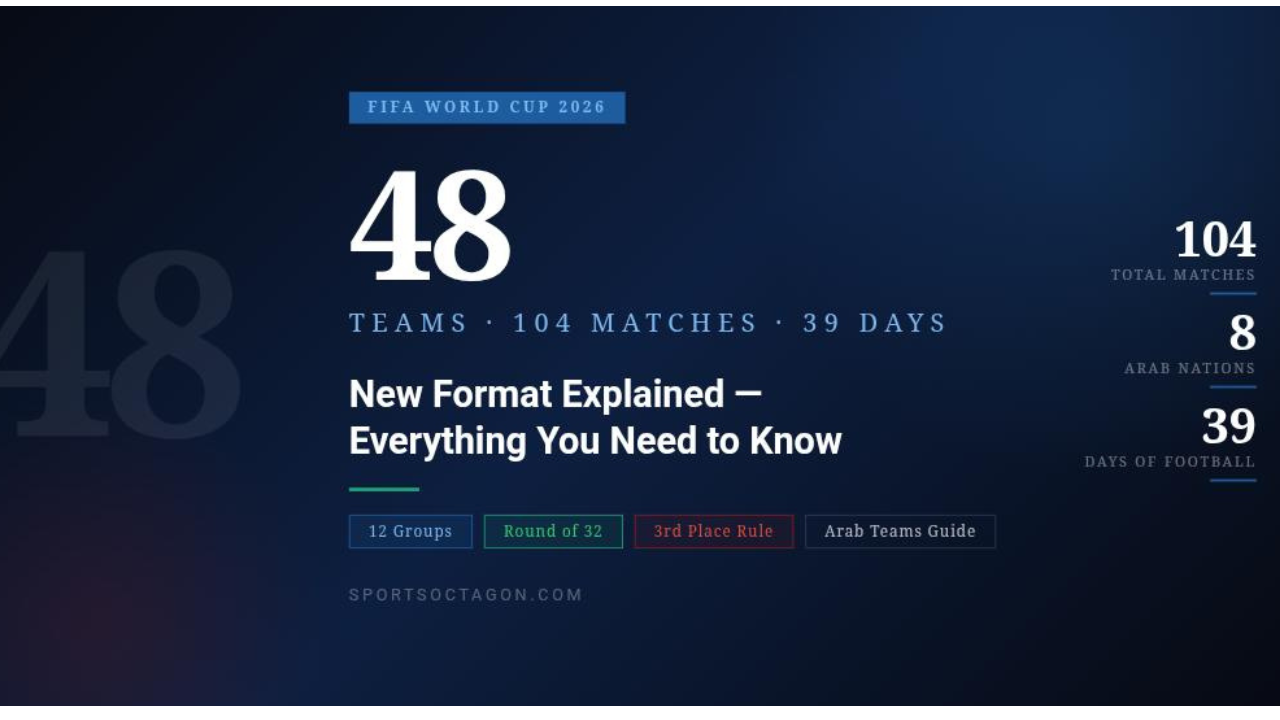
The FIFA World Cup 2026 format is the biggest change to the tournament in almost 30 years ” and millions of casual fans still do not fully understand how it works. If you have been asking yourself why there are suddenly 48 teams, what a Round of 32 is, or how a third-place team can still qualify for the knockout stage, this is the complete guide you need.
Everything you need to know about the new format, the new rules, the 12 groups, and what it all means for Arab fans and the eight Arab nations competing in North America this summer ” explained simply and clearly.
Why Did FIFA Change the World Cup Format
For 28 years ” from the 1998 tournament in France all the way through to Qatar 2022 ” the World Cup had the same format: 32 teams, 8 groups of 4, and 64 total matches. It was clean, simple and familiar to every football fan on the planet.
So why change it?
FIFA expanded the World Cup to 48 teams starting from 2026, representing an additional 16 teams from the previous format. The reasons are threefold. First, more nations get the opportunity to compete on football’s biggest stage ” giving smaller footballing countries a realistic chance to qualify. Second, more teams mean more matches, more broadcast deals, and significantly more commercial revenue for FIFA. Third, it gives every confederation a stronger representation ” the 2026 FIFA World Cup will be the first tournament in which all six confederations have at least one guaranteed berth.
The result is a fundamentally different tournament. Bigger, longer, more inclusive ” but also more complex to understand. Let us break it down step by step.
The Group Stage ” 12 Groups of 4 Teams
The group stage is where most of the changes begin, though it will feel familiar once you understand it.
The 48 teams are split into twelve groups of four teams each. Each team plays three group matches ” one against every other team in their group. This part has not changed from previous tournaments. You still play three games, you still earn 3 points for a win, 1 for a draw and 0 for a loss.
What has changed is how many teams advance from each group. In the old 32-team format, only the top 2 teams from each of the 8 groups advanced ” 16 teams total. In the new format, the top two teams in each group advance to the knockout stage, as in previous years ” but the expansion of the tournament creates an additional round of knockout matches. Instead of 16 teams advancing to the first knockout round, there will be 32 making it out of the group stage.
That means not only do the top two teams from every group qualify ” but also the eight best third-placed teams from all twelve groups.
This is the rule that changes everything for teams like Qatar, Iraq and Jordan ” nations who might finish third in their group but still have a genuine path to the knockout rounds.
How Does the Third-Place Qualification Work ?
This is the part most fans find confusing ” so here is the clearest possible explanation.
After all 12 groups have finished their three matchdays, there will be 12 third-placed teams. Out of those 12, only the 8 best advance to the Round of 32. The other 4 go home.
The third-place teams in the group stage will be ranked by these criteria in order: points, goal difference, goals scored, team conduct score, and FIFA world ranking.
In simple terms ” if you finish third in your group, you need as many points as possible, the best goal difference, and the most goals scored to make it through. A third-place team with 4 points and a strong goal difference will almost certainly advance. A third-place team with 3 points and a poor goal difference may not.
For Qatar specifically ” finishing third in Group B with 4 points from a draw against Canada and a win over Bosnia and Herzegovina could realistically be enough to advance as one of the best eight third-placed teams. This is a genuine path that did not exist in the old format.
The Complete Knockout Path ” A Brand New Round of 32
Once the group stage ends, 32 teams remain. This is where the brand-new Round of 32 begins ” a knockout round that has never existed at a World Cup before.
Teams will now have to advance past four knockout rounds before reaching the World Cup final ” the new Round of 32, followed by the Round of 16, quarter-finals and semi-finals.
Here is the complete knockout structure from start to finish:
Round of 32 ” 32 teams, 16 matches, single elimination. Lose and you go home. The 8 third-place qualifiers are drawn against group winners from specific groups depending on which groups produced the third-place qualifiers.
Round of 16 ” 16 teams remain, 8 matches. The same knockout format football fans have known for decades.
Quarter-finals” 8 teams, 4 matches. The last 8 standing in the tournament.
Semi-finals ” 4 teams, 2 matches. One step from the final.
Third-place match ” the two losing semi-finalists compete for third place.
Final” July 19, 2026, MetLife Stadium, New Jersey. The two best teams in the world compete for the trophy.
To make the final four, teams will play a total of eight matches in the tournament instead of the previous seven. This means the champions of World Cup 2026 will have played more matches than any World Cup winner in history.
Tiebreakers ” How Does FIFA Separate Equal Teams?
When two or more teams in a group finish with the same number of points, FIFA uses a specific set of tiebreaker rules to determine the final standings.
Tiebreakers include, in order: goal differential, goals scored, head-to-head play, fair play record, and drawing of lots if needed.
This means goal difference is crucial at this World Cup. Winning matches by more than one goal, keeping clean sheets and scoring freely are all more important than ever. A team that wins all three group games 1-0 could theoretically finish below a team that wins two games and draws one if the goal differences differ significantly.
For Arab teams especially Qatar and Iraq who face difficult groups every goal matters. Do not just win. Win well.
Key Rule Changes You Need to Know
Beyond the format change, FIFA introduced several important rule adjustments specifically for this tournament.
Yellow card reset rule: FIFA has introduced adjustments to player discipline rules designed to reduce the chances of players missing major knockout matches due to accumulated bookings. Yellow cards accumulated in the group stage and Round of 32 will be wiped clean before the Round of 16 ” meaning a player who picks up two bookings in the group stage will not automatically miss the Round of 16 as they would have before.
Penalty shootout format: Knockout matches consist of two 45-minute halves in regulation. If still tied after regulation, the match goes to extra time consisting of two 15-minute halves. If still tied after extra time, the match is decided in a five-round penalty shootout. If still tied after five rounds, each subsequent round becomes sudden death.
Squad size: Teams can name a provisional squad of 35 to 55 players before the tournament, with final squads confirmed by June 2. Each team’s final squad is 26 players ” the same as 2022.
The Three Host Countries ” USA, Canada and Mexico
The tournament takes place from June 11 to July 19, 2026, jointly hosted by sixteen cities eleven in the United States, three in Mexico, and two in Canada. This makes it the first World Cup ever hosted by three nations simultaneously.
For Arab fans travelling to watch their teams, here are the key venues to know:
Levi’s Stadium, Santa Clara, California ” where Qatar face Switzerland on June 13.
BC Place, Vancouver, Canada ” where Qatar face Canada on June 18.
Lumen Field, Seattle ” where Qatar face Bosnia and Herzegovina on June 24.
MetLife Stadium, New Jersey ” the largest stadium in North America and the venue for the World Cup final on July 19. This is also where Morocco face Brazil on June 13.
The tournament will last 39 days an increase from 32 days in the 2014 and 2018 tournaments. This means more than five weeks of continuous World Cup football from the opening match to the final.
What the New Format Means for Arab Teams
The expanded 48-team format has been transformational for Arab football. Eight Arab nations qualify for a single World Cup for the first time in history ” a record that was only possible because FIFA expanded the AFC allocation from 4.5 spots to 8.5 spots.
More importantly, the third-place qualification rule gives every Arab team a second chance even if they struggle in their group. Here is an honest assessment for each:
Morocco ranked 8th in the world, are strong favourites to top Group C. They could realistically reach the quarter-finals or beyond.
Egypt in a winnable Group G with Iran, Belgium and New Zealand. If Mohamed Salah is fully fit, they can finish in the top two and advance directly.
Saudi Arabia Group H with Spain, Uruguay and Cape Verde is tough but Cape Verde is beatable. A strong run of results could see them advance as third-place qualifiers.
Qatar Group B is challenging but the Bosnia match on June 24 is winnable. A win there plus a draw against Canada could be enough to advance as a third-place qualifier under the new rules.
Iraq Group I with France, Senegal and Norway is the hardest draw for any Arab team. Their best realistic hope is as a third-place qualifier if they pick up points against Norway.
Algeria , Tunisia and Jordan all face tough groups but the third-place qualification route means a strong performance across three matches could still extend their tournament.
The new format does not just give these teams more games it gives them more hope.
Format Comparison Old vs New at a Glance
Here is a simple side-by-side comparison for fans who want to understand exactly what changed:
Number of teams: 32 (old) 48 (new)
Number of groups: 8 groups of 4 (old) 12 groups of 4 (new)
Teams advancing from group stage: 16 (old) 32 (new)
First knockout round: Round of 16 (old) Round of 32 (new)
Total matches: 64 (old) → 104 (new)
Tournament length: 32 days (old) 39 days (new)
Matches to win the title: 7 (old) 8 (new)
Last format change: 1998 (28 years ago)
Need to Know About FIFA WORLD CUP 2026
How many teams are in the World Cup 2026?
The FIFA World Cup 2026 features 48 teams an increase of 16 from the previous 32-team format that was used from 1998 to 2022. The 48 teams are split into 12 groups of 4 teams each.
How does the World Cup 2026 group stage work?
Each team plays three group matches against the other teams in their group. The top two teams from every group automatically advance to the Round of 32. Additionally, the eight best third-placed teams from all 12 groups also advance making 32 teams total in the knockout stage.
What is the Round of 32 at World Cup 2026?
The Round of 32 is a brand new knockout round introduced for the first time at World Cup 2026. It is the first elimination stage of the tournament, featuring all 32 teams who qualified from the group stage. Lose in the Round of 32 and you are eliminated. This round did not exist in any previous World Cup.
How many matches are in the World Cup 2026?
The FIFA World Cup 2026 features 104 total matches a significant increase from the 64 matches played at every World Cup between 1998 and 2022. The extra matches come from the expanded group stage and the new Round of 32.
Can a third-place team qualify for the knockout stage at World Cup 2026?
Yes. The eight best third-placed teams from all 12 groups advance to the Round of 32 alongside the 24 group winners and runners-up. Third-place teams are ranked by points, goal difference, goals scored, fair play record and FIFA world ranking. This gives teams like Qatar and Iraq a genuine second chance even if they do not finish in the top two of their group.
When does the World Cup 2026 start and end?
The FIFA World Cup 2026 begins on June 11, 2026 with the opening match between Mexico and South Africa in Mexico City. The final takes place on July 19, 2026 at MetLife Stadium in New Jersey, USA. The tournament runs for 39 days in total.
Which countries are hosting the World Cup 2026?
The FIFA World Cup 2026 is co-hosted by three countries the United States, Canada and Mexico across 16 cities. It is the first World Cup ever hosted by three nations simultaneously. The final will be played at MetLife Stadium in New Jersey.
Conclusion
The FIFA World Cup 2026 format is bigger, bolder and more exciting than any previous tournament in history. For Arab fans, it represents an unprecedented opportunity eight nations competing, new rules that give every team a second chance through third-place qualification, and 104 matches of world-class football spread across 39 days.
Yes, the format is more complicated than before. But once you understand the 12 groups, the third-place qualification system and the new Round of 32, it all makes perfect sense. More teams, more drama, more moments and for the first time in history, the Arab world will have eight stories to follow at once.
The tournament starts June 11. Now you know exactly how it works.
Want to know how Qatar will perform in Group B? Read our complete guide: Qatar World Cup 2026: Group B Fixtures, Schedule and Can They Qualify?
Covering all eight Arab teams Read: 8 Arab Teams at World Cup 2026 Groups, Fixtures, Key Players and Predictions
Which new rule do you think helps Arab teams the most the Round of 32 or the third-place qualification? Tell us in the comments below 👇
Read More : FIFA World Cup 2026 USA Schedule: All Matches, Dates & Stadiums Across the United States