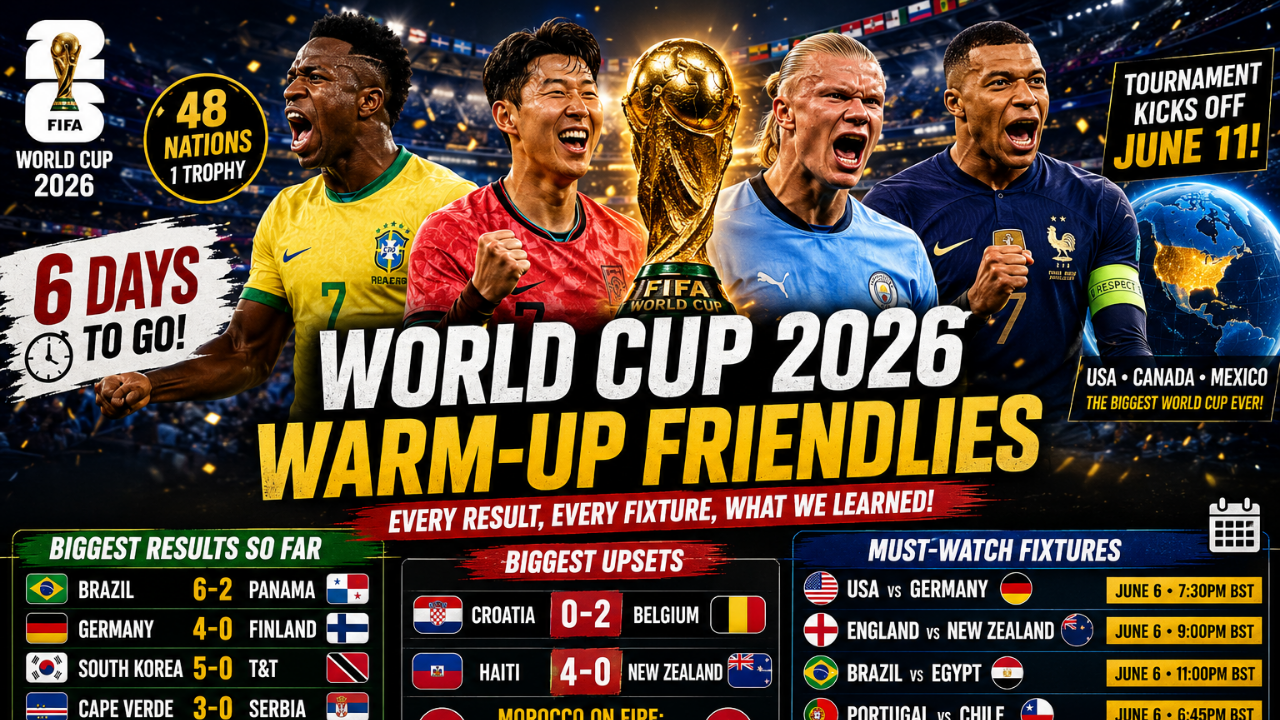
World Cup 2026 Warm-Up Friendlies: Every Result, Every Fixture and What We Learned Before June 11

World Cup 2026 Warm-Up Friendlies: Every Result, Every Fixture and What We Learned Before June 11

Every World Cup 2026 warm-up friendly result and fixture from May 26 to June 10 — with analysis, predictions and form guide. Brazil 6-2 Panama, Germany 4-0 Finland and every match before June 11.

June 5, 2026 | By Hemim SK | Sports Octagon
The FIFA World Cup 2026 kicks off in six days. Every one of the 48 nations is in final preparation mode — playing warm-up friendlies, testing squads, sharpening tactics and giving managers one last look at their options before the tournament begins. Some teams have looked frightening. Some have raised serious alarm bells. And some results have already given us the biggest clues about who is ready and who is not.
This is your complete guide to every World Cup 2026 warm-up friendly — every result already played, every fixture still to come between now and June 10, and the key things we learned from each game.

Bookmark this page. We will update it as results come in.

World Cup 2026 Warm-Up Friendlies — Key Facts

Total nations playing friendlies: 48
Friendly window: May 26 — June 10, 2026
World Cup opening match: Mexico vs South Africa, June 11, Mexico City
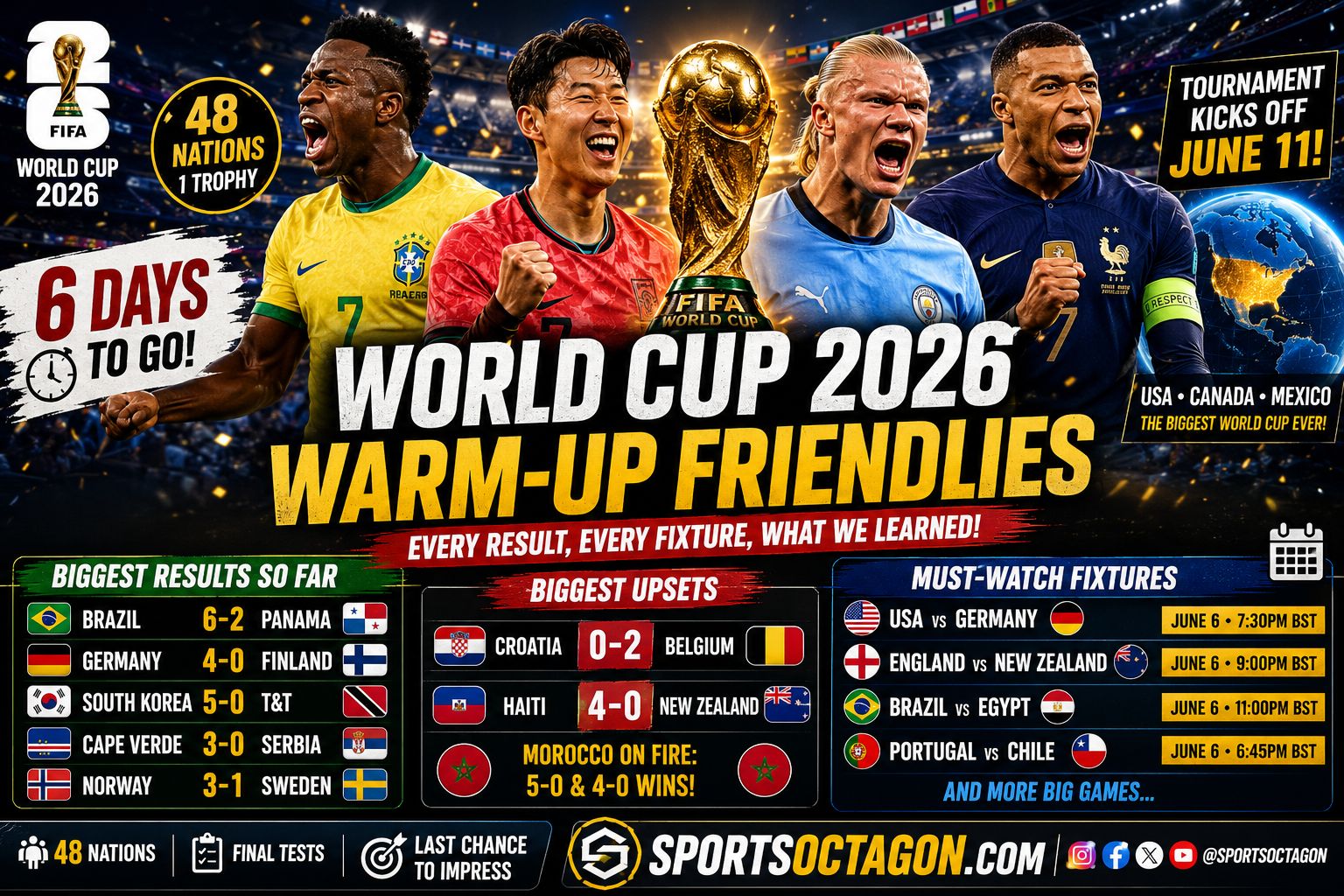
Biggest friendly result so far: Brazil 6-2 Panama (May 31)
Most impressive performance: Germany 4-0 Finland (May 31)
Biggest upset: Croatia 0-2 Belgium (June 2)
Last friendlies before tournament: June 10, 2026
World Cup 2026 Warm-Up Friendlies: Every Result, Every Fixture and What We Learned Before June 11

RESULTS ALREADY PLAYED

Tuesday May 26
Morocco 5-0 Burundi
Morocco opened their pre-tournament schedule with a statement. Five goals, clean sheet, Achraf Hakimi involved throughout. The Atlas Lions are not here to ease into things. They look sharp, organised and genuinely hungry. Burundi were outclassed from the first whistle.
What we learned: Morocco’s attack looks as dangerous as it did when they reached the semi-finals in Qatar. Do not underestimate them in Group C against Brazil and Scotland.

Egypt 1-0 Russia
A tight, professional win for Egypt. Mohamed Salah did not start but came on for the second half and immediately lifted the tempo. The goal came from a set piece — a sign of Egypt’s organised, disciplined style under their coaching staff.
What we learned: Salah is being managed carefully ahead of the tournament. Egypt will not be easy to beat in Group G. He looks fit, sharp and motivated for what could be his final World Cup.

Republic of Ireland 1-0 Qatar
Ireland — not at the World Cup — gave Qatar a tight test. Qatar struggled throughout, looking uncertain in both defence and attack. Their Group B assignment alongside Canada and Switzerland already looks very difficult based on this performance.

What we learned: Qatar will need a massive improvement to survive the group stage. A repeat of their 2022 home tournament exit looks likely.

Friday May 29
Iran 3-1 Gambia
Iran, one of Asia’s strongest sides, were comfortable winners. Three goals, controlled performance, clean defensive organisation for most of the match. Their World Cup group — shared with New Zealand and Belgium — suddenly looks more interesting.
What we learned: Iran are organised and dangerous on the counter. Belgium cannot afford to take them lightly in Group G.

Iraq 1-0 Andorra
A narrow win over Andorra is not exactly a statement — but Iraq looked purposeful and disciplined in their first warm-up game. Their World Cup debut in Group B will be an enormous step up.
What we learned: Iraq are building confidence ahead of their first World Cup. Beating Andorra was the expected result but the performance was composed.
South Africa 0-0 Nicaragua
South Africa — who play the World Cup opening match against Mexico on June 11 — played out a goalless draw with Nicaragua. Not the result Bafana Bafana wanted. Their attack looked toothless and creativity was limited throughout.

What we learned: This is concerning for South Africa. They face Mexico on the biggest possible stage in six days and they could not score against Nicaragua. Expect a difficult opening game for them.
Bosnia 0-0 North Macedonia
A flat, uninspiring draw between two nations not at the World Cup. Nothing notable to report.

Saturday May 30
Scotland 4-1 Curaçao
Scotland ran out convincing winners against World Cup debutants Curaçao in what was a real test for both sides. Four goals showed Scotland’s attacking quality, particularly down the left side. Curaçao showed energy and desire but were physically outmatched.
What we learned: Scotland look well-organised under their manager and should be competitive in Group C. For Curaçao, this was a reality check — Group E with Germany and Ivory Coast awaits. But they showed they will never give up.

Sunday May 31
Brazil 6-2 Panama
The headline result of the entire pre-tournament window. Brazil were electric. Six goals, free-flowing attacking football, Vinicius Jr running defenders ragged, Rodrygo and Raphinha combining beautifully. The front line looked like one of the most exciting attacking units in world football when firing at full speed.
What we learned: Brazil are coming to the World Cup with a point to prove after years of underperformance in major tournaments. This was the most complete attacking display of any team in the pre-tournament window. Group C opponents Morocco and Scotland should be very worried.
Germany 4-0 Finland
Germany looked clinical, organised and exactly what a team under tournament pressure needs to look — dangerous and controlled at the same time. Florian Wirtz was outstanding. Kai Havertz led the line effectively and Jamal Musiala pulled strings throughout. Four goals, clean sheet, zero drama.
What we learned: Germany have sorted out their tactical identity. Under Julian Nagelsmann they finally look like a team that knows exactly what it wants to do. After humiliating early exits in 2018 and 2022, this Germany side looks like a genuine contender. Group E opponents Ivory Coast and Ecuador must have watched this nervously.
United States 3-2 Senegal
A thriller in the pre-tournament window. The USA led twice, Senegal equalised twice, then the hosts grabbed a late winner. Christian Pulisic was dangerous throughout. But Senegal’s talent was equally evident — their front line caused problems all night and only poor finishing kept the score down.
What we learned: The USA look ready to entertain their home crowd. Pulisic is in excellent form. Senegal meanwhile are genuinely dangerous — this scoreline flatters no one and both teams showed World Cup-level quality. Their Group I clash with France is must-watch television.
Japan 1-0 Iceland
Japan ground out a professional, disciplined win. Their defensive structure was excellent, their pressing high and organised. The single goal came from a well-worked team move. Iceland created very little.
What we learned: Japan under their manager are tactically one of the most sophisticated teams in Asia. They have beaten Germany and Spain at recent World Cups. Netherlands fans in Group F should be very aware of what this team is capable of.
South Korea 5-0 Trinidad and Tobago
A comfortable, confidence-building win for South Korea. Son Heung-min was lively and involved in several goals. The squad depth looks impressive and the tactical shape was disciplined throughout.
What we learned: South Korea look sharp, confident and well-organised. They are dark horses in Group A alongside Mexico. Do not write them off.
Switzerland 4-1 Jordan
Switzerland were efficient and clinical against World Cup debutants Jordan. Four goals, controlled performance, exactly what a well-organised European side should deliver against a team of Jordan’s level.
What we learned: Switzerland will be competitive in Group B. Jordan face an enormous challenge at the World Cup — their 34-year wait for this moment is real, but the quality gap against Europe’s stronger nations is also real.
Mexico 1-0 Australia
Mexico, as tournament hosts, are under enormous pressure and this narrow win over Australia reflected that tension. One goal from a set piece, limited attacking creativity, but the clean sheet was important.
What we learned: Mexico are cautious, defensively solid but not yet convincing going forward. They will need their home crowd on June 11 against South Africa. The pressure is enormous and this performance showed some nerves.
Cape Verde 3-0 Serbia
One of the most surprising and exciting results of the pre-tournament window. Cape Verde — World Cup debutants — beat Serbia comfortably with three well-worked goals. The performance showed genuine quality, organisation and belief.
What we learned: Do not sleep on Cape Verde. They beat Cameroon to qualify and now they have beaten Serbia in a friendly. They are not at the World Cup to make up numbers. Group C with Brazil and Morocco will be brutal, but this performance showed they belong.
Ecuador 2-1 Saudi Arabia
Ecuador won a competitive, physical friendly against Saudi Arabia. Two good goals, direct attacking play, and a solid defensive performance for long periods.
What we learned: Ecuador are organised and dangerous. Saudi Arabia — who face Spain and Uruguay in Group H — still look inconsistent. Their famous 2022 win over Argentina seems a long time ago now.
Norway 3-1 Sweden
Norway were magnificent. Erling Haaland scored twice, looked sharp, fit and completely focused. Three goals against a solid Sweden side — not a weak opponent — was a statement of intent from a nation many are backing as the World Cup’s biggest dark horse.
What we learned: Haaland is ready. Norway are ready. If France vs Norway happens in Group I — as the draw suggests — that is one of the most anticipated group-stage matches in World Cup history. Mbappé vs Haaland, live, on the world stage.
Poland 0-2 Ukraine
Ukraine won convincingly against Poland in an emotionally charged fixture. Playing in front of a passionate crowd and carrying the weight of their nation’s ongoing situation, Ukraine’s players showed tremendous spirit and quality.
What we learned: Ukraine — still to be confirmed as qualifiers via their playoff — are a talented side. If they reach the tournament they will not be easy opponents for anyone.
Austria 1-0 Tunisia
A tight, professional win for Austria. One goal, clean sheet, controlled performance. Austria are one of Europe’s most quietly improved nations and their World Cup group could be more competitive than expected.
What we learned: Austria are solid, well-organised and capable. They are not a glamour team but they will make life very difficult for Argentina in Group J.
Turkey 4-0 North Macedonia
Turkey were dominant and impressive. Four goals against a decent opponent, attacking football throughout. Hakan Çalhanoğlu controlled the midfield and the front three looked sharp and co-ordinated.
What we learned: If Turkey qualify through their playoff they arrive at the World Cup in serious form. This was a convincing, dominant performance.

Tuesday June 2
Colombia 3-1 Costa Rica
Colombia were excellent. Three goals, fluid passing, James Rodríguez orchestrating from deep. The 35-year-old playmaker looked rejuvenated and motivated ahead of what could be his final World Cup. Darwin Núñez-level opposition this is not — but Colombia looked dangerous and well-organised.
What we learned: Colombia are one of the most dangerous sides in South America right now. Their Group K clash with Portugal is a genuine contest — not a foregone conclusion.
Canada 2-0 Uzbekistan
Canada beat World Cup debutants Uzbekistan with two well-taken goals. The performance showed Canada’s physical power and direct attacking style. Playing at the World Cup on home soil, with their own fans, Canada have genuine momentum.
What we learned: Canada are ready. Uzbekistan meanwhile face a brutal reality check — their Group K contains Portugal and Colombia. This loss to Canada will have given them useful information about what the tournament level demands.
Croatia 0-2 Belgium
The biggest upset of the pre-tournament window. Croatia — semi-finalists in 2018, finalists in 2022 — were beaten convincingly by Belgium. Two well-taken Belgian goals, Croatia unable to find a way through. It raised questions about whether Croatia’s golden generation has finally faded.
What we learned: Croatia look tired and limited without the creativity of their peak years. Belgium meanwhile look sharp and dangerous. Their Group G assignment alongside Egypt and Iran is suddenly looking very manageable. For England fans — who face Croatia in Group L — this result might be quietly welcome news.
Morocco 4-0 Madagascar
Morocco continued their superb pre-tournament form with another big win. Four goals, another clean sheet, Hakimi and the front line combining brilliantly. Morocco look like a team that has improved since their incredible 2022 run.
What we learned: Morocco are coming. Four-nil against Madagascar after five-nil against Burundi. The Atlas Lions are firing on every cylinder. Brazil and Scotland — take note.
Wales 1-1 Ghana
A competitive, entertaining friendly that ended level. Both sides showed quality in attack but also defensive vulnerabilities. Ghana’s Premier League talent throughout the squad was evident, with several players delivering strong individual performances.
What we learned: Ghana will be competitive in Group L alongside England and Croatia. England cannot afford to be complacent. This draw showed Ghana have quality.
Wednesday June 3
Haiti 4-0 New Zealand
Haiti — with approximately 85% of their squad born abroad — were outstanding. Four goals against New Zealand, who are also at the World Cup, was a genuine statement. The performance showed exactly why Haiti’s diaspora recruitment model works.
What we learned: Haiti are not here to make up numbers. Four goals against a World Cup nation is an impressive result. Their Group C opponents will have been paying attention.
FIXTURES STILL TO COME — June 4 to June 10

Thursday June 4 — RESULTS
Spain 1-1 Iraq — La Coruña
Fabrizio Romano’s reaction said it all — “IRAQ STOP SPAIN!” Spain took the lead through Ferran Torres on 16 minutes but World Cup debutants Iraq equalised through Mahmoud Doski on 27 minutes and held on for a remarkable draw. For a nation making their first World Cup appearance, drawing with the reigning Euro 2024 champions is an enormous confidence boost.
What we learned: This is a genuine alarm bell for Spain. Iraq — who face Group B opponents at the World Cup — showed they are not just here to make up numbers. Spain’s defence looked uncertain and their inability to break down a disciplined lower-ranked side is a concern heading into the tournament in six days. Luis de la Fuente will have serious questions to answer.
France 1-2 Ivory Coast — Nantes
The shock result of the entire pre-tournament window. Ivory Coast — a team many consider Group E underdogs behind Germany — beat World Cup favourites France 2-1 in Nantes. Rayan Cherki gave France the lead on 45 minutes but Gbamin Doué equalised on 53 minutes before Aboubakar Diallo scored the winner on 84 minutes to complete a stunning upset.
Fabrizio Romano’s post read simply: “WHAT ARE IVORY COAST COOKING?!
What we learned: This is one of the most significant results of the entire pre-tournament period. France losing to Ivory Coast — who are in Group E not Group I — raises genuine questions about their defensive organisation and mental focus. More importantly it confirms what we suspected: Ivory Coast are dangerous. Germany face them in Group E and cannot afford any complacency. Ivory Coast just beat France. They can beat anyone on their day.
Sweden 2-2 Greece — Stockholm
An entertaining draw between two nations not at the World Cup. Viktor Gyökeres scored twice for Sweden — on 53 and 69 minutes — but Greece fought back through Kostas Tsimikas on 10 minutes and a dramatic 90+5 equaliser from Giorgos Masourás. A goal in the final minute of stoppage time made it a thrilling finish.

What we learned: Gyökeres is in fine form — two goals and plenty of attacking intent. Sweden narrowly missed World Cup qualification and matches like this show why they will be a force in future tournaments.
South Korea 1-0 El Salvador — Sandy, Utah
South Korea ground out a professional, disciplined win over El Salvador as expected. Son Heung-min’s side showed good defensive organisation and controlled the game throughout.
What we learned: South Korea are steady and well-organised. No alarms, no surprises — exactly what a team heading into a World Cup needs.
Panama 2-0 Dominican Republic — Panama City
Panama won comfortably as expected against Dominican Republic, continuing their World Cup preparations with a clean sheet and a controlled performance.
What we learned: Panama look solid and organised ahead of their Group L fixtures against England and Croatia.

Friday June 5
Mexico vs Serbia — Toluca, 3am BST
The hosts face a tough test in Serbia. This is a serious warm-up game for El Tri — Serbia are a physical, well-organised European side. Mexico need a convincing performance to settle any nerves after their narrow win over Australia.
Results : Mexico 5-1 Serbia
Paraguay vs Nicaragua — Asunción, 11:15pm BST
Paraguay warm up for Group D. Nicaragua are not at the tournament so this is a confidence exercise.
Results : Paraguay 4-0 Nicaragua
Guatemala vs Czechia — Harrison, New Jersey, 1am BST
Czechia are not at the World Cup. An interesting test for Guatemala.
Results: Czechia 3-1 Guatemala

Saturday June 6 — THE BIG DAY
Belgium vs Tunisia — Brussels, 2pm BST
Belgium face one of their Group G opponents in this friendly. Tunisia and Belgium are in the same group at the World Cup — this game carries genuine significance. Both managers will be watching for tactical information.
Must watch.

Results: Belgium 5-0 Tunisia

Portugal vs Chile — Lisbon, 6:45pm BST
Cristiano Ronaldo leads Portugal in what could be one of his final games on home soil before his last World Cup. Chile are not at the tournament but this is a tough physical test. Expect Ronaldo to start and be hungry for goals.
Results: Portugal 2-1 Chile

USA vs Germany — Chicago, Soldier Field, 7:30pm BST
One of the standout friendlies of the entire pre-tournament window. Host nation USA against tournament favourites Germany. Christian Pulisic vs Florian Wirtz. A genuine preview of what both teams could produce at the World Cup. Massive game.
Must watch.

Results: USA 1-2 Germany

England vs New Zealand — Tampa, 9pm BST / ITV
England’s penultimate warm-up game before their World Cup opener against Croatia. New Zealand are at the World Cup in Group G. England should win — but the performance will matter. Fans want to see fluency, goals and confidence. Harry Kane leads the line.
Must watch.

Results: England 1-0 New Zealand

Brazil vs Egypt — Cleveland, Ohio, 11pm BST / ITV
After their magnificent 6-2 win over Panama, Brazil face a much tougher test. Egypt — with Mohamed Salah in the squad — will make this a real contest. The South American giants need to show they can handle defensive organisation as well as attacking brilliance.
Must watch.

Results: Brazil 2-1 Egypt

Australia vs Switzerland — San Diego, 8pm BST
Two Group B nations facing each other directly. Genuine World Cup rehearsal value. Both managers will learn something important from this game about their opponents’ strengths and weaknesses.
Must watch.

Results: Switzerland 1-1 Australia

Scotland vs Bolivia — Harrison, NJ, 9pm BST / BBC
Scotland’s final warm-up before their World Cup opener. Bolivia are not at the tournament but Scotland need goals, confidence and momentum. The nation will be watching.
Results: Scotland 4-0 Bolivia

Panama vs Bosnia — St. Louis, 8pm BST
Panama prepare for Group L.
Results: Panama 1-1 Bosnia
El Salvador vs Qatar — Los Angeles, 9pm BST
Qatar need a performance here after their narrow win over Republic of Ireland raised concerns.
Results: El Salvador 0- 0Qatar
Venezuela vs Turkey — Fort Lauderdale, 11pm BST
Turkey — potentially heading to the World Cup via playoff — continue preparations.
Results: Turkey 2-1 Venezuela
Canada vs Republic of Ireland — Montreal, 12:30am BST
Canada’s penultimate warm-up game on home soil. Should be a comfortable win.
Results: Canada 1-1Republic of Ireland
Haiti vs Peru — Miami, 1am BST / Premier Sports
After their impressive 4-0 win over New Zealand, Haiti face a much harder test in Peru. This will reveal whether Haiti’s form is genuine World Cup-level quality.
Results: Haiti 1-2 Peru

Sunday June 7
Argentina vs Honduras — College Station, Texas, 1am BST
Lionel Messi leads Argentina in their penultimate warm-up game. Honduras are not at the World Cup. Expect Messi to play and expect goals. Argentina need confidence and sharpness ahead of their Group J opener against Algeria.
Must watch.

Results: Argentina 2-0 Honduras

Morocco vs Norway — Harrison, NJ, 8pm BST / ITV
The single most anticipated friendly of the entire pre-tournament window. Africa’s champion vs Europe’s dark horse. Achraf Hakimi vs Erling Haaland. Both teams have looked exceptional in their warm-up results. Morocco unbeaten and scoring freely. Norway with Haaland in brilliant form after his brace against Sweden. This is effectively a World Cup preview match — and both teams are in the same group.
The must-watch game of the entire pre-tournament window.

Results: Morocco 1-1 Norway

Croatia vs Slovenia — Varaždin, 7:45pm BST
Croatia need a strong response after their 0-2 defeat to Belgium. Slovenia are not at the World Cup. Croatia must win and win well to rebuild confidence before Group L.
Results: Croatia 2-1 Slovenia

Ecuador vs Guatemala — Columbus, Ohio, 9pm BST
Ecuador continue their World Cup preparations.
Results: Ecuador 3-0 Guatemala
Monday June 8
Netherlands vs Uzbekistan — New York City, 7:45pm BST
Netherlands — who face Uzbekistan in Group F at the actual World Cup — play the World Cup debutants in a direct warm-up match. This game is as close to a World Cup rehearsal as it gets. Both managers will take notes. Uzbekistan will want to show they belong at this level.
The most tactically significant friendly of the window.

Results : Netherlands 2-1 Uzbekistan

France vs Northern Ireland — Lille, 8:10pm BST / BBC
France’s penultimate warm-up. Northern Ireland are not at the World Cup. France should win easily and focus on sharpening combinations ahead of their Group I opener against Senegal.

Results: France 3-1 Northern Ireland

Colombia vs Jordan — San Diego, 12am BST
Colombia face World Cup debutants Jordan. Another direct warm-up against a group-stage opponent — Colombia and Jordan meet in Group J. James Rodríguez will be tested by Jordan’s physical, organised defence.
Results: Colombia 2-0 Jordan

Tuesday June 9
Peru vs Spain — Puebla, Mexico, 3am BST
Spain’s final warm-up before the World Cup. Peru are not at the tournament. Expect Spain to test their squad depth and give fringe players game time while ensuring their key players are sharp and rested.

Results: Spain 3-1 Peru

Congo DR vs Chile — Cádiz, 4pm BST
Two nations not at the World Cup facing each other. A useful fitness and form exercise.
Results: Congo DR 1-2 Chile

Wednesday June 10 — FINAL DAY BEFORE THE WORLD CUP
Argentina vs Iceland — Auburn, Alabama, 2am BST
Argentina’s final warm-up before the World Cup. Messi’s last preparation game before his sixth and final World Cup tournament. Iceland are not at the tournament. Argentina will want to go into June 11 full of confidence and goals.
Must watch — Messi’s final warm-up game. Prediction: Argentina 3-0 Iceland
Portugal vs Nigeria — Leiria, 8:45pm BST
Ronaldo’s final warm-up before his last World Cup. Nigeria are not at the tournament but always present a physical, athletic challenge. Portugal want a commanding performance to take into their Group K opener.
Prediction: Portugal 2-0 Nigeria
England vs Costa Rica — Orlando, 9pm BST / ITV
England’s final warm-up game before the World Cup. Costa Rica are not at the tournament. This is the last chance for manager to finalise his starting XI, check fitness and send a message of confidence to the nation. It has to be a dominant, fluent, convincing win.
England’s most important warm-up result. Prediction: England 3-0 Costa Rica
Saudi Arabia vs Senegal — San Antonio, 12am BST
Saudi Arabia — who face Spain and Uruguay in Group H — take on Senegal, who are in Group I. Both need good results before the tournament opens. Senegal showed quality in their 3-2 loss to the USA and will be motivated.
Prediction: Senegal 2-1 Saudi Arabia

Form Table — Who Looks Ready and Who Doesn’t
Looking EXCELLENT — Fear these teams at the World Cup:
Brazil — 6-2 Panama. Electric, free-flowing, unstoppable on their day
Germany — 4-0 Finland. Clinical, organised, Wirtz and Musiala in top form
Morocco — 5-0 Burundi, 4-0 Madagascar. Dominant and hungry
Norway — 3-1 Sweden. Haaland in brilliant form, team looks sharp
Belgium — 2-0 Croatia. Confident, well-structured, dangerous in attack
South Korea — 5-0 Trinidad and Tobago. Sharp, disciplined, Son leading brilliantly
Cape Verde — 3-0 Serbia. The genuine surprise package of pre-tournament football
Looking SOLID — Competitive but not yet convincing:
Japan — 1-0 Iceland. Professional and disciplined but low on attacking flair
Colombia — 3-1 Costa Rica. James Rodríguez looking sharp, squad depth impressive
Canada — 2-0 Uzbekistan. Physical and direct, home advantage will be huge
USA — 3-2 Senegal. Exciting and attacking but defensively fragile
Mexico — 1-0 Australia. Solid but lacking attacking spark on home turf
Ecuador — 2-1 Saudi Arabia. Organised and effective but not yet convincing
Looking CONCERNING — Questions to answer before June 11:
South Africa — 0-0 Nicaragua. Cannot score goals. Opening match against Mexico is very worrying
Croatia — 0-2 Belgium. Has the golden generation finally faded?
Qatar — 1-0 Republic of Ireland. Narrow, uncertain, struggling to impose themselves
Argentina — Not yet played. Everything depends on Messi’s fitness and form

Frequently Asked Questions
When do the World Cup 2026 warm-up friendlies end?
The final pre-tournament friendlies take place on Wednesday June 10, 2026 — the day before the World Cup opens on June 11 with Mexico vs South Africa in Mexico City.
Which World Cup 2026 warm-up friendly is the most important?
Morocco vs Norway on Sunday June 7 is the standout game of the entire pre-tournament window. Both nations are in Group I at the actual World Cup — making it a direct preview match between two of the tournament’s most exciting teams.
Did Brazil really score 6 goals in a warm-up friendly?
Yes. Brazil beat Panama 6-2 on May 31 in the most eye-catching pre-tournament result of the window. Vinicius Jr, Rodrygo and Raphinha all featured in a free-flowing attacking display.
How did England perform in their World Cup warm-up matches?
England face New Zealand on June 6 and Costa Rica on June 10 as their main warm-up fixtures ahead of the World Cup. Their pre-tournament form will be assessed as those results come in.
Which teams are playing each other in World Cup group stage warm-up friendlies?
Several group-stage rivals are playing each other directly — most notably Morocco vs Norway (Group I), Netherlands vs Uzbekistan (Group F), Australia vs Switzerland (Group B) and Belgium vs Tunisia (Group G). These games carry the most tactical significance of any pre-tournament friendlies.
What was the biggest surprise result in the World Cup 2026 warm-up friendlies?
Cape Verde 3-0 Serbia stands out as the biggest surprise — World Cup debutants beating an experienced European nation convincingly. Croatia 0-2 Belgium was also a major shock given Croatia’s recent World Cup pedigree.
Is Lionel Messi playing in Argentina’s warm-up friendlies?
Argentina play Honduras on June 7 and Iceland on June 10. Messi is expected to feature in both games as he prepares for what will almost certainly be his sixth and final FIFA World Cup.

Conclusion
Six days. 48 nations. One tournament. The World Cup 2026 warm-up window has already told us enormous amounts about who is ready and who is not. Brazil are terrifying. Germany look reborn. Morocco look dangerous. Haaland looks unstoppable. And Cape Verde — a nation of 600,000 people — just beat Serbia 3-0.
The big games still to come — USA vs Germany, Brazil vs Egypt, Morocco vs Norway, England vs New Zealand — will add the final pieces of the puzzle before June 11 changes everything.
Stay with Sports Octagon. We will update this article with every result as it happens.

Read next: Real Madrid Transfer News Today: Konaté Signed, Dumfries Medical Done, and Riquelme Promises Haaland and Rodri Before Sunday Election
Full tournament guide: FIFA World Cup 2026 USA Schedule: All Matches, Dates & Stadiums Across the United States

Which pre-tournament friendly result surprised you the most — and which team’s form has you most excited for the World Cup? Tell us in the comments!

Real Madrid Transfer News Today: Konaté Signed, Dumfries Medical Done, and Riquelme Promises Haaland and Rodri Before Sunday’s Election

Real Madrid Transfer News Today: Konaté Signed, Dumfries Medical Done, and Riquelme Promises Haaland and Rodri Before Sunday's Election

June 4, 2026 | By Hemim SK | Sports Octagon
Real Madrid‘s most dramatic week in years is unfolding in real time. Fabrizio Romano has posted “Here We Go” on both Ibrahima Konaté and Denzel Dumfries. Konaté has officially signed a four-year contract until June 2030. Dumfries has passed his medical in Holland and the €20 million release clause has been formally activated. And on the other side of the election battle, presidential candidate Enrique Riquelme has gone on live television and promised — under a notarised personal guarantee — that both Erling Haaland and Rodri will join Real Madrid if he defeats Florentino Pérez on Sunday June 7.
Three transfer headlines. One election. One club. Everything decided in the next 72 hours.

This is your complete Real Madrid transfer update for June 4, 2026.

Real Madrid Transfer News Today — Key Facts

Konaté status: Signed. Contract until June 2030. Four-year deal confirmed by Fabrizio Romano
Konaté fee: Free transfer — contract at Liverpool expired June 30, 2026
Dumfries status: Medical passed in Holland. Release clause officially activated
Dumfries fee: €20 million release clause triggered by Real Madrid
Mourinho status: Approved both signings. Appointment confirmed pending election result
Presidential election: Sunday June 7, 2026 — Florentino Pérez vs Enrique Riquelme
Riquelme promise: Haaland AND Rodri if he wins — backed by notarised personal guarantee
Konaté previous club: Liverpool (joined from RB Leipzig 2021, contract expired 2026)
Dumfries previous club: Inter Milan (207 appearances, 27 goals, 5 seasons)

Real Madrid Transfer News Today: Konaté Signed, Dumfries Medical Done, and Riquelme Promises Haaland and Rodri Before Sunday's Election

CONFIRMED: Ibrahima Konaté Signs for Real Madrid on a Free Transfer

Fabrizio Romano posted “HERE WE GO” from his verified Instagram account and the caption said everything: Ibrahima Konaté signs in as new Real Madrid player for four years.
Fabrizio Romano confirmed that Real Madrid have a verbal agreement in place with Ibrahima Konaté, with a four-year deal to be signed depending on Florentino Pérez being re-elected. Konaté put Saudi bids on hold for Real Madrid.
That deal is now done. The contract runs until June 2030. Konaté’s departure from Anfield was officially announced on Sunday evening, with the player saying he was “deeply saddened” at not being able to say goodbye to the fans. Just two days later, the Frenchman agreed to a four-year contract with Real Madrid

Liverpool is preparing to lose a second defender to Real Madrid in 12 months, with Ibrahima Konaté set to follow Trent Alexander-Arnold to the Spanish capital. Konaté had been in talks with Liverpool over an extension, but negotiations stalled, and now the club will lose a valuable asset for nothing

The Konaté story is a masterclass in Real Madrid’s modern transfer strategy. Real Madrid have been in talks with Konaté’s agents over a possible deal since February 2026. Madrid’s message was clear: allow your contract to expire, walk away from Anfield for free, then join as part of their next era — the same strategy they used successfully to sign Trent Alexander-Arnold from the same club
Kylian Mbappé’s role in the potential deal also came to light, with the France international — Konaté’s international teammate — reportedly having informal conversations with the defender about life at the Bernabéu
At 27 years old and entering the peak years of his career, Konaté arrives as a finished product. Dominant in the air, physical in the tackle, composed with the ball at his feet and already proven at Champions League level with Liverpool. He will slot alongside Antonio Rüdiger to form what could be the most commanding centre-back partnership in La Liga next season.

CONFIRMED: Denzel Dumfries Passes Medical, Release Clause Activated

The second “Here We Go” of the day. Fabrizio Romano confirmed exclusively that Denzel Dumfries has passed his medical for Real Madrid in Holland and the €20 million release clause has been officially activated.
Real Madrid sent the official document to Inter Milan activating the clause. Dumfries completed his medical on Dutch soil before flying to Madrid. The deal is 100% confirmed.
Real Madrid have reportedly reached an agreement to sign Inter Milan right-back Denzel Dumfries, with the Netherlands international set to become one of the first additions of the club’s summer rebuild. The Spanish giants activated the €20 million release clause in Dumfries’ contract having already agreed personal terms with the 30-year-old defender.

At €20 million, Dumfries may end up being one of the bargains of the 2026 transfer window. He made 232 appearances across five seasons at Inter, winning two Serie A titles, three Coppa Italia trophies and three Supercoppa Italiana titles

With 34-year-old Dani Carvajal leaving when his contract ends in June, Real Madrid would only have Trent Alexander-Arnold left as a senior right-back. Dumfries fixes that problem instantly. He is physical, disciplined defensively, and capable of driving forward with power — exactly the profile Mourinho has always demanded from his full-backs.

Dumfries could compete for the starting spot with Trent Alexander-Arnold. As a physical and offensive-minded right-back with strong defensive instincts, it is likely that Mourinho deploys him in the starting lineup against elite teams.

Both Konaté and Dumfries will first represent France and the Netherlands respectively at the World Cup 2026 before officially beginning their Real Madrid careers. Real Madrid management was eager to finalise negotiations before the tournament began to avoid a rise in player values and competition from other clubs. Smart business. Executed perfectly

The Election Wild Card: Riquelme Goes on TV and Promises Haaland and Rodri

While Pérez’s camp was completing the Konaté and Dumfries deals, his presidential rival Enrique Riquelme was on prime time Spanish television making the most explosive promises in Real Madrid election history.
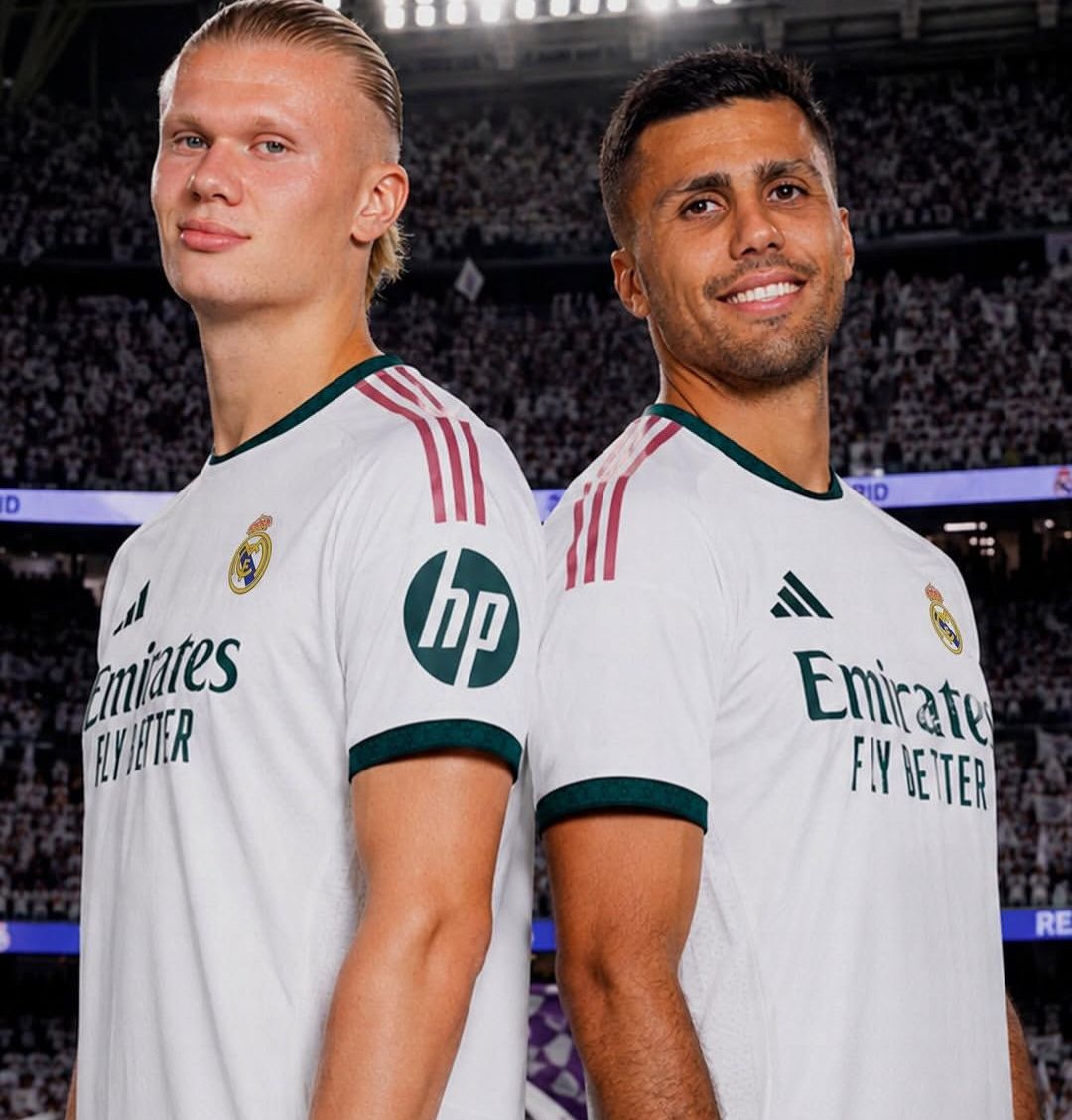
Speaking on El Hormiguero, Riquelme revealed that he will sign Erling Haaland if elected as Real Madrid president this weekend. He claimed that the Norwegian striker is keen to join the Bernabéu club and that he is able to do so via a clause in his Manchester City contract. Riquelme also claimed that Haaland’s Manchester City teammate Rodri would also join if he was elected

Real Madrid Transfer News Today: Konaté Signed, Dumfries Medical Done, and Riquelme Promises Haaland and Rodri Before Sunday's Election

And then Riquelme did something no presidential candidate had done before. He backed it with money. His own money. Riquelme went as far as to say he would personally cover the membership fees of all Real Madrid members if he broke his promise —

“If I fail to comply with it I will pay 100% of the entire fee of the 100,000 members of Real Madrid.”

The devastating Scandinavian star from Manchester City would view a change positively after Pep Guardiola’s departure from the club. Haaland scored 38 goals and provided nine assists in 52 official matches last season.

On Rodri, Riquelme added: “The Spanish national team will have a player, and we will not go through the painful shame of not having any Real Madrid players in the Spanish national team. I would like Rodri to play for Real Madrid.”

These are extraordinary claims. Haaland is under a long-term contract at Manchester City. Rodri is one of the most important players in European football. Moving either to Madrid would be the transfer story of the decade. But Riquelme is an outsider candidate facing the man who has been Real Madrid president since 2009, and the polls overwhelmingly favour Pérez. These are expected to be the first contested Real Madrid presidential elections since 2006.

Whether Riquelme’s promises are football reality or election theatre, one thing is certain — the 100,000 Real Madrid members voting on Sunday have a genuinely historic choice in front of them

What Happens Next — The 72-Hour Timeline

Thursday June 5: Dumfries and Konaté deals formally processed. Both players join their national squads for World Cup 2026 preparations.
Sunday June 7: Real Madrid presidential election. Polls open 9am, close 8pm at the Real Madrid City Basketball Pavilion. Florentino Pérez is the heavy favourite.
After election: José Mourinho officially confirmed as Real Madrid head coach. Konaté and Dumfries contracts formally signed and announced.
June 11: FIFA World Cup 2026 begins. Both new signings represent France and Netherlands.
July 2026: Konaté and Dumfries arrive at Valdebebas for pre-season. The Mourinho era officially begins.

Need To Know

Has Ibrahima Konaté officially signed for Real Madrid?
Yes. Fabrizio Romano confirmed with his “Here We Go” post that Konaté has signed a four-year contract with Real Madrid until June 2030. The deal is done, with formal announcement expected after the presidential election on June 7.

How much did Real Madrid pay for Ibrahima Konaté?
Nothing. Konaté joins Real Madrid on a free transfer after his contract at Liverpool expired on June 30, 2026. He rejected contract renewal offers from Liverpool and turned down lucrative Saudi Pro League bids to join Real Madrid.

Has Denzel Dumfries passed his medical for Real Madrid?
Yes. Fabrizio Romano confirmed exclusively that Dumfries passed his medical in Holland and Real Madrid have sent the official document to Inter Milan activating his €20 million release clause. The transfer is 100% confirmed.

How much did Real Madrid pay for Denzel Dumfries?
Real Madrid activated Dumfries’ €20 million release clause in his Inter Milan contract. No transfer negotiation was needed — the clause simply had to be triggered.

Who is Enrique Riquelme and why is he promising Haaland and Rodri?
Enrique Riquelme is a Spanish businessman and founder of renewable energy company COX Energy who is challenging Florentino Pérez in Real Madrid’s presidential election on June 7. He appeared on Spanish TV show El Hormiguero and promised to sign both Erling Haaland and Rodri if elected, backing the promise with a personal notarised guarantee to pay 100% of membership fees for all 100,000 Real Madrid members if he fails.

Will Erling Haaland actually join Real Madrid?
This is based entirely on Enrique Riquelme’s election promise. Florentino Pérez is the overwhelming favourite to win the election, making Riquelme’s promises unlikely to be tested. However, Riquelme has claimed Haaland has a release clause at Manchester City and wants to join Madrid.

Is José Mourinho confirmed as Real Madrid manager?
Mourinho’s appointment is verbally agreed and expected to be officially confirmed immediately after the presidential election on June 7, provided Florentino Pérez wins as expected.

When will Konaté and Dumfries start playing for Real Madrid?
Both players will first represent their national teams — France and the Netherlands — at the FIFA World Cup 2026, which begins June 11. They are expected to join Real Madrid for pre-season training in July 2026.

Why did Ibrahima Konaté leave Liverpool?
Konaté and Liverpool could not reach agreement on a new contract. His deal expired June 30, 2026. Real Madrid reportedly advised him to let the contract run down and join as a free agent — the same strategy they used to sign Trent Alexander-Arnold from Liverpool 12 months earlier.

Conclusion
Real Madrid’s summer 2026 is already one of the most significant in the club’s modern history — and it is only June 4.
Konaté confirmed. Signed until 2030. Free. Dumfries confirmed. Medical done. €20 million. Mourinho approved both. Election Sunday. Riquelme promising Haaland and Rodri on live television with his personal fortune as guarantee.

Whatever happens on Sunday, Real Madrid are moving. Under Mourinho, with Konaté and Rüdiger at the heart of defence and Dumfries competing with Alexander-Arnold at right-back, Los Blancos are building the most defensively solid squad they have had in years — and they are doing it fast, smart and before the rest of Europe even knows the World Cup has started.
Stay with Sports Octagon for every update as the election results come in Sunday and the Mourinho era officially begins.

Read next:FIFA World Cup Top Scorers: Last Six Editions — Mbappe, Kane, James Rodriguez & Every Golden Boot Winner Ranked
More news:Argentina World Cup 2026 Squad: Full Official 26-Man List, Messi’s Final Dance & La Albiceleste Predictions

Pérez with Mourinho, Konaté and Dumfries — or Riquelme with Haaland and Rodri? Which direction would you choose for Real Madrid? Tell us in the comments!

Real Madrid’s Summer Revolution: Ibrahima Konaté and Denzel Dumfries Confirmed as First Signings of the Mourinho Era

Real Madrid‘s summer rebuild is already underway — and it is happening faster than anyone expected. Fabrizio Romano has confirmed that Denzel Dumfries will join Real Madrid from Inter Milan after Los Blancos activate his €20 million release clause. Ibrahima Konaté, meanwhile, has reached a verbal agreement with the club after walking away from contract talks at Liverpool. José Mourinho has personally approved both signings.
Real Madrid have agreed a deal to sign Inter Milan defender Denzel Dumfries, with Ibrahima Konaté also expected to join the club at the Santiago Bernabeu. Both arrivals are part of a sweeping defensive overhaul as the club enters a new era under the returning Mourinho — and both deals are being pushed through before the World Cup kicks off on June 11.
This is not a slow summer rebuild. This is Real Madrid moving at full speed.

Real Madrid Summer 2026 Transfer Update — Key Facts

Dumfries fee: €20 million release clause triggered Konaté fee: Free transfer (contract expired at Liverpool) Mourinho status: Approved both signings personally Presidential election: June 7 — Florentino Pérez expected to win Target: Both deals completed before World Cup 2026 begins June 11 Dumfries age: 30 Konaté age: 27 Dumfries previous club: Inter Milan (207 appearances, 27 goals) Konaté previous club: Liverpool (joined from RB Leipzig in 2021) Why now: Dani Carvajal leaving, David Alaba out, defensive rebuild urgent

Denzel Dumfries — The €20M Bargain Real Madrid Could Not Ignore

Real Madrid have reportedly reached an agreement to sign Inter Milan right-back Denzel Dumfries, with the Netherlands international set to become one of the first additions of the club’s summer rebuild. The Spanish giants are expected to activate the €20 million release clause in Dumfries’ contract, having already agreed personal terms with the 30-year-old defender.
The timing could not be more important. With 34-year-old Dani Carvajal leaving when his contract ends in June, Real Madrid would only have Trent Alexander-Arnold left as a senior right-back. That is not a sustainable situation for a club with Champions League ambitions. Dumfries changes everything.
At €20 million, Dumfries may end up being one of the bargains of the 2026 transfer window. He made 232 appearances across five seasons at Inter. He won two Serie A titles, three Coppa Italia trophies and three Supercoppa Italiana titles. This is a player who has won consistently at the highest level of club football. He knows what pressure looks like and he performs under it.
Dumfries will be Carvajal’s replacement and could compete for the starting spot with Trent Alexander-Arnold. As José Mourinho has given the green light to this signing, he is a physical, offensive-minded right-back with better defensive instincts than Trent, so it is likely that Mourinho deploys him in the starting lineup against elite teams.
For Mourinho — a manager who has always demanded defensive solidity before anything else — Dumfries is exactly the profile he wants. Aggressive, physical, experienced and capable of providing width going forward. At €20 million for a Netherlands international with five years of top-level Serie A experience, this deal will be remembered as one of the most efficient pieces of business in Madrid’s recent history.

Ibrahima Konaté — Liverpool’s Loss, Madrid’s Greatest Gain

The Konaté saga has been one of the most dramatic transfer stories of 2026. Ibrahima Konaté’s future has been shaping up as a defining transfer saga, with Real Madrid pushing hard while Liverpool continued their efforts to keep hold of him. Madrid have been making moves in the background, encouraging him to avoid extending his stay at Anfield — their message being that he should wait it out so he can walk away for free, then step into the Bernabeu as part of their next era. It is a strategy they used successfully when Trent Alexander-Arnold made the same move.
It worked. Again.
Ibrahima Konaté has reportedly reached an agreement to reinforce Real Madrid’s defensive line. The arrival of the French defender would be linked to the victory of Florentino Pérez as president. After the departure of David Alaba and the inconsistencies of Dean Huijsen, Los Blancos see Konaté’s arrival as a complete defensive boost. As one of Liverpool’s most consistent players, the 27-year-old would arrive to form the starting centre-back partnership with Antonio Rüdiger.
The importance of this signing cannot be overstated. Real Madrid’s centre-back position has been a problem for two seasons. Militão has struggled with injuries. Huijsen and Asencio have shown promise but not the consistent elite-level reliability a club of Madrid’s stature demands. Konaté changes the equation entirely.
At 27 years old, he is entering the peak years of his career. He is physically imposing, dominant in the air, composed on the ball and has experience of Champions League football with Liverpool. He arrives at the Bernabeu not as a project but as a finished product — ready to start from day one.
Konaté is seen as the main candidate to replace David Alaba, whose spot at centre-back became available after a series of injuries and inconsistent performances by other defenders. The club is confident that this transfer will strengthen a problematic position, given Militão’s physical issues and the unconvincing displays from Huijsen.

José Mourinho — Why His Approval Changes Everything

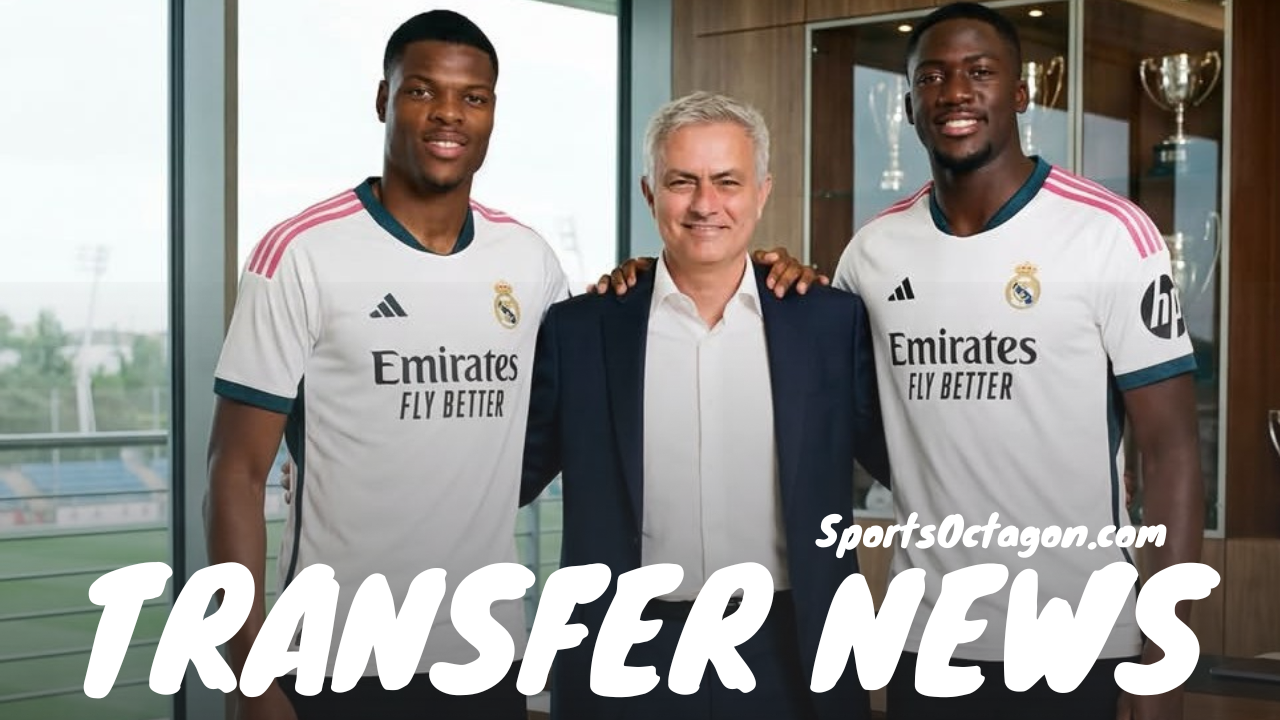
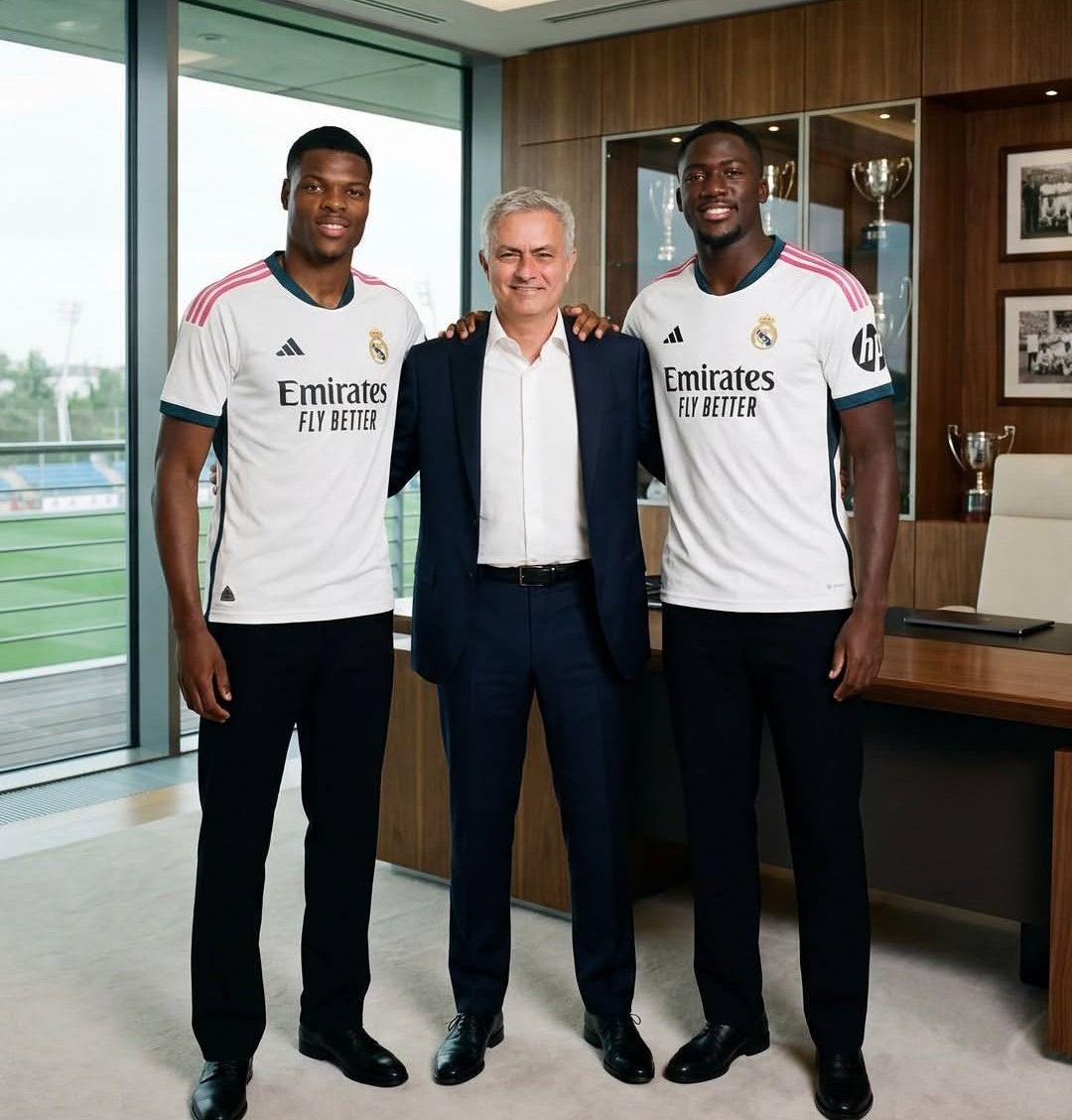
The photograph circulating across social media tells the complete story. Mourinho standing between Konaté and Dumfries, all three in Real Madrid white, smiling inside what appears to be the club’s training complex offices. This is not a leaked image. This is a statement.
Mourinho’s return to Real Madrid — the club where he won La Liga, the Copa del Rey and two Spanish Super Cups during his first spell from 2010 to 2013 — is the defining story of European football this summer. And his first act as incoming manager is to personally endorse and approve two defensive signings that address Madrid’s two most urgent problems simultaneously.
The deal is expected to receive approval from José Mourinho, who is set to take over the team after the elections. That approval has now been given publicly and visibly. Mourinho knows exactly what he wants from this squad and he is already building it.
A physical, experienced right-back. A dominant, aggressive centre-back. Mourinho’s teams have always been built from the back and organised around defensive solidity. With Rüdiger and Konaté at centre-back and Dumfries at right-back, the foundation he is laying at the Bernabeu has the potential to be the most solid defensive unit in La Liga next season.

The Presidential Election — The One Remaining Obstacle
Both Konaté and Dumfries have been selected by France and the Netherlands for the upcoming World Cup. Real Madrid intend to finalise both transfers before the tournament begins on June 11.
Real Madrid management is eager to finalise negotiations before the tournament begins to avoid a rise in player values and competition from other clubs. It is smart business. Once these players perform on the World Cup stage in front of a global audience, the price and the competition for their signatures will only increase.
The one formal obstacle remaining is Real Madrid’s presidential election on June 7. Florentino Pérez is widely expected to be re-elected. The arrival of the French defender is contingent on the victory of Florentino Pérez as president. Should Pérez win — as most inside the club expect — both deals will be formalised within days.
The election is four days away. The transfers are ready. The manager has approved them. The players have agreed terms. Everything points in one direction.

What These Signings Mean for Real Madrid 2026-27
Madrid are rebuilding their defensive spine entirely in a single summer window — and doing it efficiently.
Konaté arrives for free, bringing elite Premier League and Champions League experience. Dumfries arrives for €20 million — a release clause fee that looks almost laughably low for an established international with his trophy record and quality. Together they cost Madrid around €20 million total for two proven, international-level defenders in the peak of their careers.
With Trent Alexander-Arnold already at the club and now competing with Dumfries for the right-back position, and Rüdiger partnering Konaté at centre-back, the Mourinho era at the Bernabeu is taking shape rapidly. Add in the young quality of Huijsen and Asencio as depth options and Madrid have constructed one of the most competitive defensive squads in Europe almost overnight.
Real Madrid under Mourinho, with this defensive foundation, will not be easy to beat. Any team planning to open them up next season should start worrying now.

Need To Know

Is the Denzel Dumfries to Real Madrid transfer confirmed?

Yes. Fabrizio Romano has confirmed the agreement. Real Madrid will activate Dumfries’ €20 million release clause from Inter Milan. Personal terms have been agreed and the deal is effectively done pending formal completion.

Is Ibrahima Konaté joining Real Madrid?

Konaté has reached a verbal agreement with Real Madrid after his contract at Liverpool expired. The deal is contingent on Florentino Pérez winning the Real Madrid presidential election on June 7, which he is widely expected to do.

How much are Real Madrid paying for Denzel Dumfries?

Real Madrid are triggering Dumfries’ release clause, which is reported to be between €20 million and €25 million depending on the source. At that price for an established international defender, it represents outstanding value.

Is Ibrahima Konaté a free transfer to Real Madrid?

Yes. Konaté’s contract at Liverpool expired in summer 2026. He rejected a contract renewal at Anfield and will join Real Madrid on a free transfer — a similar path to the one Trent Alexander-Arnold took to the same club.

Has José Mourinho approved the Konaté and Dumfries signings?

Yes. Mourinho has personally approved both transfers according to multiple reports including Fabrizio Romano. The photograph of Mourinho alongside both players in Real Madrid training wear has circulated widely on social media and confirms his involvement in the process.

When will Real Madrid officially announce Konaté and Dumfries?

Real Madrid plan to finalise both deals before the FIFA World Cup 2026 begins on June 11. The presidential election on June 7 is the final formal step needed before announcements are made.

Why did Real Madrid sign Dumfries?


Dani Carvajal is leaving Real Madrid when his contract expires in June 2026, leaving a gap at right-back. Dumfries was identified as the ideal replacement — an experienced, physical, attack-minded full-back who can also partner with Trent Alexander-Arnold in a versatile defensive system under Mourinho.

Why did Ibrahima Konaté leave Liverpool?


Konaté did not reach an agreement with Liverpool on a new contract. Real Madrid reportedly encouraged him to allow his contract to expire so he could join on a free transfer — the same approach they used successfully to sign Trent Alexander-Arnold from the same club.

Conclusion
Real Madrid’s summer 2026 transfer window has begun at full speed. Two defensive signings. Two international-level players. One free transfer. One bargain release clause. José Mourinho’s approval stamped on both.
Konaté brings the elite centre-back quality Madrid have been missing since peak Sergio Ramos. Dumfries brings the defensive solidity and attacking threat at right-back that Carvajal provided for a decade. Together they give Mourinho exactly the defensive foundation his style of football demands.
The presidential election on June 7 is the final formality. After that, Real Madrid will officially begin the Mourinho era — and it is starting with a statement. Los Blancos are back, they are building fast, and the rest of Europe should be paying attention.

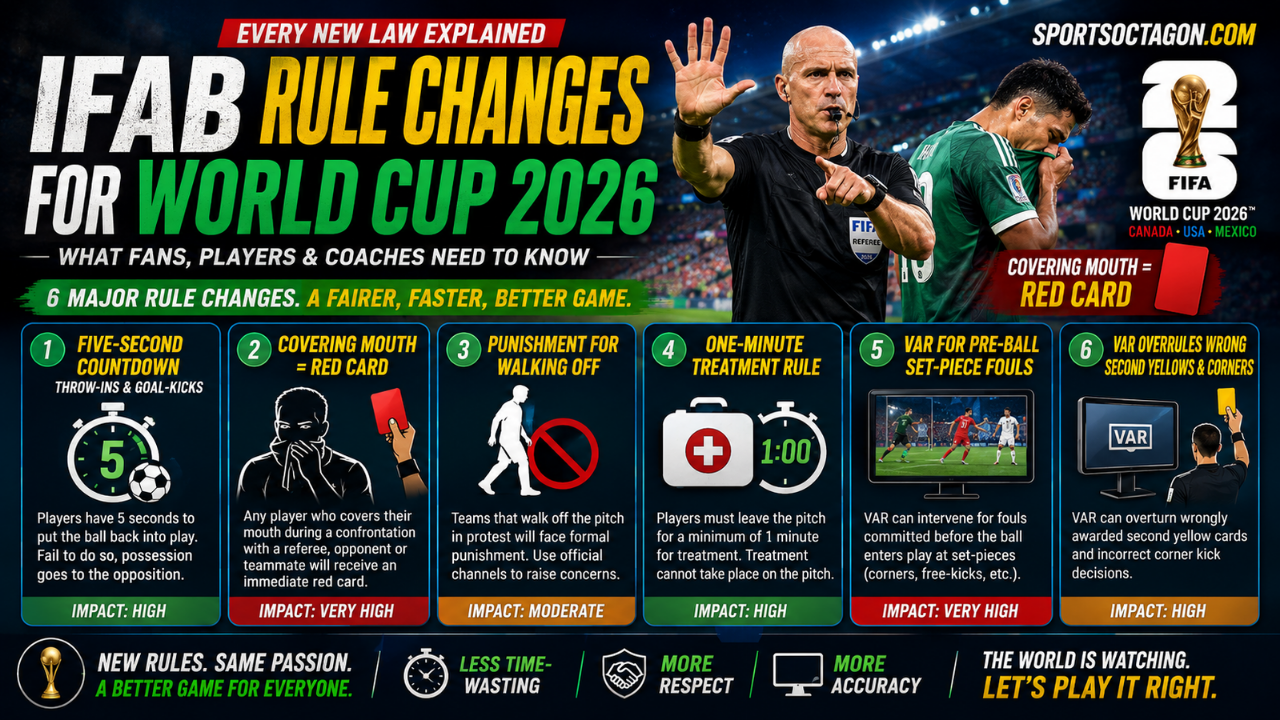
Read next: IFAB Rule Changes for World Cup 2026: Every New Law Explained — Red Cards, VAR, Five-Second Countdown & More
FIFA World Cup News : FIFA World Cup 2026 USA Schedule: All Matches, Dates & Stadiums Across the United States

Are Konaté and Dumfries the right signings to rebuild Real Madrid’s defence under Mourinho — or does the squad still need more? Tell us in the comments!

Real Madrid have agreed deals to sign Ibrahima Konaté on a free transfer and Denzel Dumfries for €20 million as José Mourinho personally approves both signings. Full transfer breakdown and analysis on Sports Octagon.

Panini FIFA World Cup 2026 Sticker Album: Where to Buy, Download, and Collect

Panini FIFA World Cup 2026 Sticker Album: Where to Buy, Download, and Collect

Search interest in the Panini FIFA World Cup 2026 sticker album is rising fast. Here’s where to buy the official collection, download the digital app, and find premium options.The Panini FIFA World Cup 2026 sticker album is already drawing major attention as fans search for the official collection, premium bundle options, and digital alternatives ahead of the tournament. Early interest suggests the classic World Cup collectible is once again set to become one of football’s biggest fan products.

Panini FIFA World Cup 2026 Sticker Album Gains Momentum as Fans Rush to Collect Early

By SportsOctagon Desk | June 2026

Interest in the Panini FIFA World Cup 2026 sticker album is rising fast, with fans already searching for the official album, starter packs, hard cover editions, and digital alternatives ahead of the tournament. The surge in search activity reflects the long-running popularity of World Cup sticker collecting, one of football’s most recognizable fan traditions.
Panini’s official storefronts now list multiple World Cup 2026 products, including the album on its own, starter kits, box bundles, and hard cover options. In the U.S., Panini America lists the official album at $5, a Tin Starter Kit at $60, and a 50-count box at $100. In Europe, Panini’s official shop also shows pre-sale and bundle listings, including hard cover album sets and packet boxes priced in euros.
The early demand matters because the World Cup sticker album has become more than a collectible. For many supporters, it is a seasonal ritual tied to the tournament’s build-up, with fans buying albums, trading duplicates, and tracking squad updates long before kickoff. The 2026 edition is drawing added attention because it covers the first 48-team FIFA World Cup, making the collection larger and more ambitious than previous editions.

Where to buy Panini FIFA World Cup 2026 sticker

The most reliable place to buy the official physical album is Panini’s own store. Panini America and Panini’s regional online shops are currently carrying the FIFA World Cup 2026 collection, including starter packs and packet bundles.
Other retailers may also carry the album. CVS has a product listing for the Panini FIFA World Cup 2026 Sticker Album, though stock and availability can vary by region and time.

Where to download Panini FIFA World Cup 2026 sticker

There is no official verified free download of the physical Panini World Cup 2026 sticker album in the sources reviewed. The official digital option is the FIFA Panini Collection app, which is available on Google Play and the Apple App Store.
The app is listed as free to download with in-app purchases on Apple’s store, and Google Play identifies it as the official FIFA Panini Collection by Coca-Cola. That makes it the safest digital option for fans who want a legitimate collectible experience without buying paper packets.

Also Read Argentina World Cup 2026 Squad Full Official 26-Man List Messi & Final Dance La Albiceleste Predictions

Free versus premium Panini FIFA World Cup 2026 sticker

For fans looking for a free option, the safest route is the official digital app, which can be downloaded at no upfront cost but may include paid features or purchases. For the physical collectible, there is no verified official free album download from Panini in the sources reviewed.
Premium options include the album itself, packet boxes, tin kits, and larger collector bundles sold through official Panini stores. In the U.S., Panini also notes free shipping on eligible orders over $50 for registered users. In Europe and the UK, Panini’s official stores list multiple premium bundles in different formats and price points.

FAQ About Panini FIFA World Cup 2026 sticker

Is the Panini FIFA World Cup 2026 sticker album available now?
Yes. Panini’s official stores currently list the World Cup 2026 sticker collection and related bundles.
Where can I buy it?
The official sources include Panini America, Panini’s international store, Panini UK, and some retail partners such as CVS.
Can I download it for free?
There is no verified official free download of the physical album. The official digital alternative is the FIFA Panini Collection app, which is free to download with in-app purchases.
Is there a premium version?
Yes. Panini sells premium bundles, including hard cover album packages, box sets, and collector editions.
Is the app official?
Yes. The FIFA Panini Collection app is listed on Google Play and the Apple App Store as the official digital sticker album experience.
{
“@context”: “https://schema.org”,
“@type”: “FAQPage”,
“mainEntity”: [
{
“@type”: “Question”,
“name”: “Where can I buy the Panini FIFA World Cup 2026 sticker album?”,
“acceptedAnswer”: {
“@type”: “Answer”,
“text”: “The official Panini FIFA World Cup 2026 sticker album is available through Panini’s official online stores and selected retail partners.”
}
},
{
“@type”: “Question”,
“name”: “Can I download the Panini FIFA World Cup 2026 sticker album for free?”,
“acceptedAnswer”: {
“@type”: “Answer”,
“text”: “There is no verified official free download for the physical album. The official digital version is available through the FIFA Panini Collection app.”
}
},
{
“@type”: “Question”,
“name”: “Is there a premium version of the Panini FIFA World Cup 2026 album?”,
“acceptedAnswer”: {
“@type”: “Answer”,
“text”: “Yes. Panini offers premium bundles such as starter kits, box sets, and hard cover album editions.”
}
},
{
“@type”: “Question”,
“name”: “Is the FIFA Panini Collection app official?”,
“acceptedAnswer”: {
“@type”: “Answer”,
“text”: “Yes. The FIFA Panini Collection app is the official digital sticker album experience listed on major app stores.”
}
},
{
“@type”: “Question”,
“name”: “Why is the Panini World Cup 2026 sticker album trending?”,
“acceptedAnswer”: {
“@type”: “Answer”,
“text”: “Search interest is rising because fans are looking for the official album, sticker book versions, hard cover editions, and digital collecting options ahead of the tournament.”
}
}
]
}

First-Time Nations at World Cup 2026: The Stories Nobody Told You

First-Time Nations at World Cup 2026: The Stories Nobody Told You

The FIFA World Cup 2026 will be remembered for many things. Lionel Messi’s final tournament. The first 48-team format. Three host nations. A final at MetLife Stadium in New Jersey.

But underneath all of that, four nations are writing a different kind of story — one that gets far less attention than it deserves.

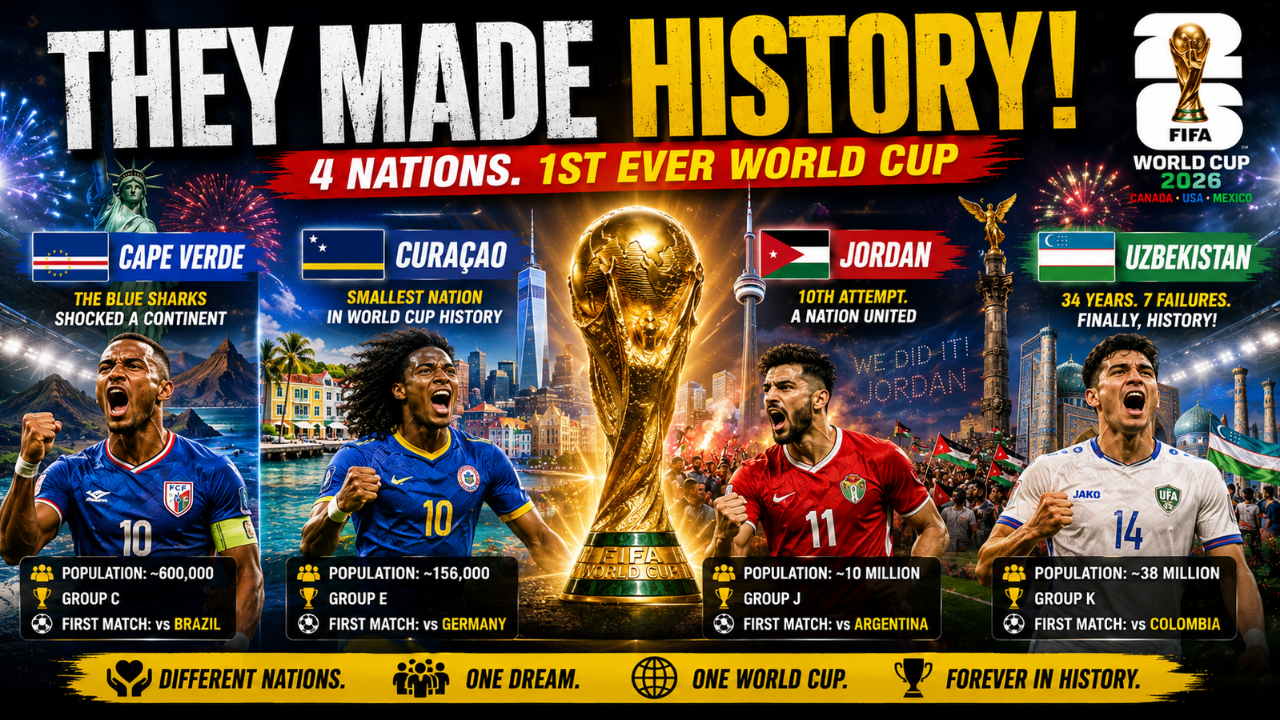
Cape Verde. Curaçao. Jordan. Uzbekistan.

These four countries will play their first-ever FIFA World Cup this summer. They are not favourites. Most fans outside their nations cannot name a single player in their squads. But their qualification journeys contain some of the most powerful stories in this entire tournament — stories of an entire nation united by a single result, of players who grew up thousands of miles from the country they now represent, and of governments, kings, and presidents who publicly wept with joy.

🇨🇻 CAPE VERDE — The Blue Sharks Who Shocked a Continent

Population: approximately 600,000
Group: C (alongside Brazil, Morocco, Scotland)
First match: vs Brazil

Imagine a volcanic archipelago of ten islands off the west coast of Africa. A country with a population roughly equal to a mid-sized European city. A national football team that only began competing in World Cup qualifying in 1990. A squad where roughly 75% of the players were born and raised not in Cape Verde itself, but in Portugal, France, the Netherlands and other European countries — connected to the islands through their parents and grandparents.

That is Cape Verde. And they are going to the World Cup.

The Blue Sharks qualified by winning their African qualifying group — a group that included Cameroon, a nation that has played at eight World Cups and produced legends like Samuel Eto’o and Roger Milla. Cape Verde lost just one of their ten qualifying matches. They arrived at the tournament not as an accidental qualifier but as a team that genuinely earned their place.

Their squad is a fascinating story of diaspora football. Players like French-born Columbus Crew captain Steven Moreira, Netherlands-born forward Garry Rodrigues and Portuguese-born midfielder Telmo Arcanjo chose to represent the islands their families came from rather than pursue careers with European nations.

One player — a goalkeeper born in Dublin to a Cape Verdean father and Irish mother — was reportedly recruited for the squad via LinkedIn. That story alone tells you everything about how modern international football works, and how Cape Verde is navigating it better than almost anyone expected.

Their group draw is brutal: Brazil and Morocco await them. But for Cape Verde, simply being there — playing under their flag, hearing their anthem, representing 600,000 people on football’s biggest stage — is already the victory.

🇨🇼 CURAÇAO — The Smallest Nation in World Cup History

Population: approximately 156,000
Group: E (alongside Germany, Ivory Coast, Ecuador)
First match: vs Germany

Let that number sink in for a moment. 156,000 people. Curaçao is a small Caribbean island — a self-governing territory within the Kingdom of the Netherlands — with a population roughly the size of a small university town. And they qualified for the FIFA World Cup.

Not only did they qualify. They became the smallest nation by population ever to reach a World Cup, breaking a record that Cape Verde had set just five weeks earlier.

How is this possible?

The answer lies in the unique relationship between Curaçao and the Netherlands. Almost the entire Curaçao squad was born in the Netherlands. Players who grew up in Dutch football — eligible for the Dutch national team — chose instead to represent the Caribbean island their families came from. Former Ajax and Barcelona star Patrick Kluivert, born to a mother from Curaçao, once coached the national side. Players like Tahith Chong (now at Sheffield United), who was the only squad member actually born on the island before moving to the Netherlands at the age of 13, are the bridge between two worlds.

The president of Curaçao’s football federation put it plainly: every player in the national team squad plays in foreign leagues. This is a team built on identity, heritage and choice — not geography.

Curaçao face Germany in Group E. The scoreline may not be kind. But 156,000 people will be watching from their tiny island in the Caribbean, living every minute of it. That is what the World Cup is for.

🇯🇴 JORDAN — A King in a Jersey, Drones Over Amman, and Ten Attempts in 34 Years

Population: approximately 10 million
Group: J (alongside Argentina, Algeria, Austria)
First match: vs Argentina — June 27, 2026

When Jordan qualified for the World Cup by beating Oman 3-0 in June 2025, the scenes that followed were unlike anything seen in Jordanian history.

In Amman, people poured into the streets. Flags were waved. Horns were honked. Songs were sung. A spectacular drone light show lit up the capital’s night sky with messages of celebration.

And King Abdullah II — attending meetings in London at the time — was photographed inside the Jordanian embassy wearing the national team’s jersey, watching the match on a screen. The image went viral around the world.

“My dear people, I am wholeheartedly happy about the qualification of our national football team to the 2026 World Cup,” the King wrote. “This historic qualification is well-deserved by our team.”

Jordan had attempted to qualify for the World Cup nine previous times. Nine times, the dream fell short. This was the tenth attempt — and it came with goals, fireworks, tears and a national celebration that coincided with the Eid al-Adha festival, adding a spiritual and cultural layer to the moment that made it feel almost destined.

The team, known as al-Nashama — which translates roughly to “the brave ones” or “patriotic heroes with a spirit of sacrifice” — carries a name first coined by a newspaper after a 1981 match against Oman. It is now the name every Jordanian football fan knows by heart.

Jordan’s honorary consul in Dallas, where their first match will be played, described the moment as “the biggest modern moment in our sport’s history — a culmination of a long football journey following nine previous attempts and finally breaking the barrier.”

And who do they face first? Reigning world champions Argentina. Lionel Messi. In a stadium in Dallas. It may not end well on the scoreboard. But for everyone wearing the red, white, black and green of Jordan that day, it will be one of the greatest moments of their lives.

🇺🇿 UZBEKISTAN — 38 Million People, 34 Years, Seven Failed Attempts

Population: approximately 38 million
Group: K (alongside Portugal, Colombia, DR Congo)
First match: vs Colombia

Of the four debut nations, Uzbekistan may carry the heaviest emotional weight.

When the Soviet Union collapsed in 1991, Uzbekistan became an independent nation — and football federation. They joined FIFA in 1994. For the next 34 years, qualification for the World Cup became the defining ambition of an entire nation and its football programme. They tried seven times. Seven times they fell short — sometimes agonisingly close, losing on goal difference in 2014 and losing to Syria in a two-legged playoff in 2018.

Then, on 5 June 2025, a 0-0 draw with the United Arab Emirates sealed it. After seven failed attempts across 34 years, Uzbekistan were going to the World Cup. They became the first Central Asian nation in history to qualify for the FIFA World Cup.

Ravshan Irmatov, the vice-president of Uzbekistan’s Football Association — himself a former World Cup referee who officiated at three previous tournaments — described what the moment meant: “Qualifying for the World Cup has been a dream for 38 million people for 34 years. You can understand how important it was for the Uzbek nation. We waited so long.”

President Shavkat Mirziyoyev, who has invested heavily in Uzbek football since 2018 including opening football academies in 14 regions nationwide, hosted the team at the presidential palace. Players and coaching staff were honoured as “Pride of Uzbekistan” and gifted new cars. Neighbouring countries including Kazakhstan, Russia and Azerbaijan sent official congratulations.

The man who led them to this moment is captain and all-time top scorer Eldor Shomurodov, on loan at Istanbul Başakşehir from AS Roma, who scored five goals during the qualifying campaign.

At the World Cup, Uzbekistan face Portugal in their group — meaning Shomurodov and his teammates will walk onto the pitch against Cristiano Ronaldo in what is almost certainly Ronaldo’s final World Cup. Two footballing stories, at completely different ends of the global football pyramid, meeting on the same pitch in the same tournament.

That is the magic of the World Cup.

What These Four Nations Mean for Football’s Future

The expansion from 32 to 48 teams has its critics. Some argue it dilutes quality. Some worry the group stage will be one-sided.

Those arguments are not entirely wrong. But they miss the bigger picture.

Cape Verde. Curaçao. Jordan. Uzbekistan. These nations are not here by accident. They earned their places. Cape Verde beat Cameroon. Curaçao navigated the competitive CONCACAF qualifying region. Jordan dominated their Asian qualifying group with 16 points. Uzbekistan finished second behind Iran across a 10-match third-round campaign, winning six and losing just once.

These are not gifted spots. These are earned ones.

And the impact of World Cup qualification extends far beyond football. In Uzbekistan, children watched the celebrations and football academies received new investment. In Jordan, a nation experiencing political tension found a unifying moment that crossed every divide. In Cape Verde and Curaçao, diaspora communities around the world felt a pull toward their roots that no government campaign could manufacture.

The World Cup has always been about more than football. The 2026 tournament — through these four nations — proves that remains more true than ever

FAQ — First-Time Nations at FIFA World Cup 2026

Which countries are making their World Cup debut in 2026?
Four nations are playing in their first-ever FIFA World Cup in 2026: Cape Verde, Curaçao, Jordan and Uzbekistan.

Which is the smallest country ever to qualify for the World Cup?
Curaçao, with a population of approximately 156,000, became the smallest nation by population ever to qualify for a FIFA World Cup in 2026.

How many times had Jordan tried to qualify for the World Cup before 2026?
Jordan had made nine previous qualifying attempts before finally qualifying for the 2026 World Cup — a 34-year journey since the nation began competing.

How did Uzbekistan qualify for the 2026 World Cup?
Uzbekistan qualified by finishing second in their AFC (Asian) qualifying group behind Iran, winning six of their ten matches. It was their first qualification after seven previous failed attempts since joining FIFA in 1994.

How many players in the Cape Verde squad were born outside Cape Verde?
Approximately 75% of Cape Verde’s World Cup squad come from the diaspora — players born in Portugal, France, the Netherlands and other countries who have family roots in the islands.

Is Curaçao really a country?
Curaçao is a self-governing territory within the Kingdom of the Netherlands located in the Caribbean Sea. It has its own FIFA membership and qualifies as a separate nation in international football.

Who are Uzbekistan’s best players at the 2026 World Cup?
Uzbekistan’s captain and all-time top scorer Eldor Shomurodov, on loan at Istanbul Başakşehir from AS Roma, is their standout player and scored five goals during World Cup qualifying.

Who is Cape Verde’s most famous footballer?
Cape Verde’s most recognisable player at the 2026 World Cup is Garry Rodrigues, a Netherlands-born forward who has played in top European leagues and is one of the team’s key attacking threats.

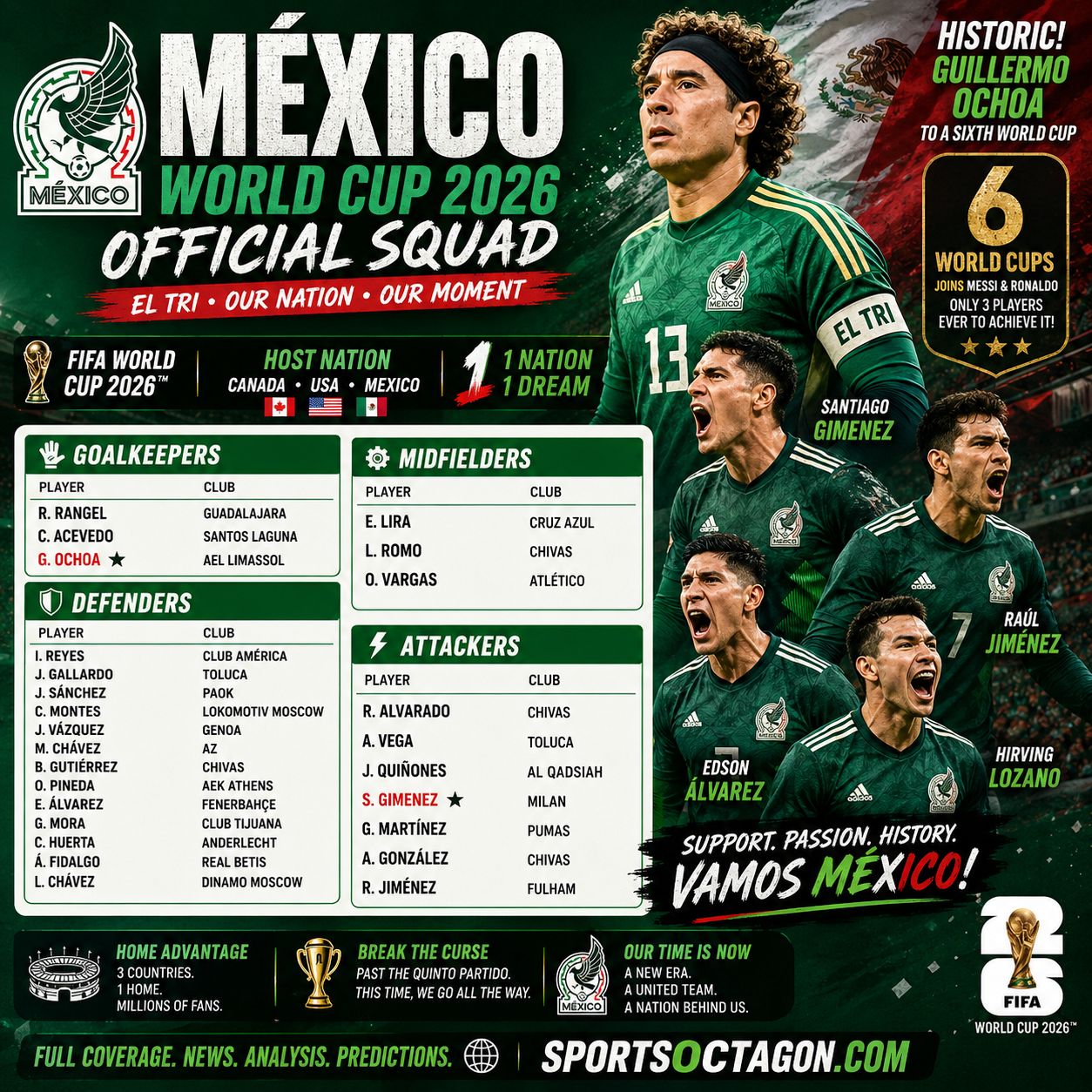
Mexico World Cup 2026 Squad: Full Official Player List, Ochoa’s Historic Sixth World Cup & El Tri Predictions

Mexico World Cup 2026 Squad: Full Official Player List, Ochoa's Historic Sixth World Cup & El Tri Predictions

Mexico have confirmed their official FIFA World Cup 2026 squad. Guillermo Ochoa heads to a historic sixth World Cup alongside Messi and Ronaldo. Full player list, key stars, tactical breakdown and predictions for the host nation.

Mexico World Cup 2026 Squad: Ochoa Makes History, Full Official Player List & El Tri Predictions
Published: June 1, 2026 | SportsOctagon Desk

History is being made before a single ball has been kicked.
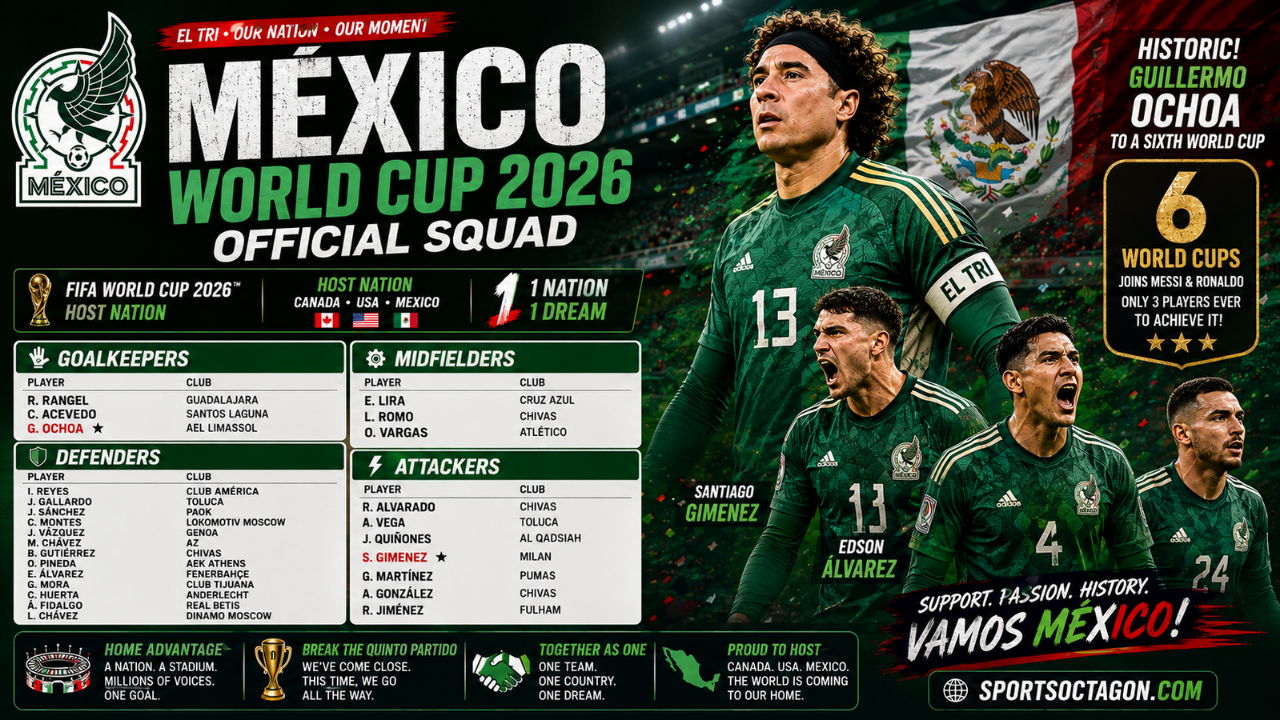
Guillermo Ochoa — Mexico’s legendary goalkeeper — has been confirmed in El Tri’s official FIFA World Cup 2026 squad, making him one of only three players in the history of football to appear at six World Cups. The other two? Lionel Messi and Cristiano Ronaldo.
Let that sink in. The greatest goalkeeper Mexico has ever produced stands alongside the two greatest outfield players the sport has ever seen in achieving something no player had ever done before this summer. Three men. Three countries. Six World Cups each. It is one of the most extraordinary statistical facts in the history of the game.
But Mexico’s World Cup 2026 story is not just about Ochoa’s remarkable achievement. As one of three host nations — alongside the USA and Canada — El Tri arrive at this tournament with the most passionate home support of any team in North America, a squad packed with European-based talent, and a burning desire to finally break through the infamous Quinto Partido curse — the barrier that has kept Mexico from reaching the quarter-finals in every World Cup since 1986.
Here is the complete, in-depth breakdown of Mexico’s official World Cup 2026 squad — every player, every club, and every reason why El Tri could finally make history on home soil.

Mexico World Cup 2026 Squad: Full Official Player List, Ochoa's Historic Sixth World Cup & El Tri Predictions
Mexico World Cup 2026 Squad Via Instagram (@Sportsoctagon)

Mexico World Cup 2026 Full Official Squad List

🧤 Goalkeepers
Player Club
R. Rangel Guadalajara
C. Acevedo Santos Laguna
G. Ochoa AEL Limassol

🛡️ Defenders
Player Club
I. Reyes Club América
J. Gallardo Toluca
J. Sánchez PAOK
C. Montes Lokomotiv Moscow
J. Vázquez Genoa
M. Chávez AZ
B. Gutiérrez Chivas
O. Pineda AEK Athens
E. Álvarez Fenerbahçe
G. Mora Club Tijuana
C. Huerta Anderlecht
Á. Fidalgo Real Betis
L. Chávez Dinamo Moscow

⚙️ Midfielders
Player Club
E. Lira Cruz Azul
L. Romo Chivas
O. Vargas Atlético

⚡ Attackers
Player Club
R. Alvarado Chivas
A. Vega Toluca
J. Quiñones Al Qadsiah
S. Gimenez Milan
G. Martínez Pumas
A. González Chivas
R. Jiménez Fulham

The Historic Story: Ochoa, Messi and Ronaldo — Three Players, Six World Cups Each

Before diving into tactics and tournament predictions, this moment deserves to be properly recognised.
No player in the history of football had ever appeared at six World Cups until the summer of 2026. Then three players did it simultaneously — and the list reads like the opening line of a football fairy tale.
Guillermo Ochoa 🇲🇽 — The Mexican goalkeeper who first appeared at a World Cup in 2006 in Germany as a 21-year-old. Twenty years later, at 41, he lines up for his sixth tournament. His career has been defined by World Cup moments — none more iconic than his extraordinary performance against Brazil in 2014, when he produced save after save to hold the five-time champions to a goalless draw. Ochoa at a World Cup is not just a footballer. He is an event.
Lionel Messi 🇦🇷 — The greatest player in football history, appearing at his sixth and almost certainly final World Cup with Argentina as the defending champions. His journey from a nervous teenager in 2006 to the man who lifted the trophy in Qatar in 2022 is the greatest individual World Cup story ever told.
Cristiano Ronaldo 🇵🇹 — Portugal’s captain and all-time top scorer, also making his sixth World Cup appearance. Like Messi, this is almost certainly his last tournament — two of the greatest players who ever lived sharing the same stage for what may be the final time.
Three legends. Three nations. One tournament. One summer. Football does not get more historic than this.

Key Players for Mexico at World Cup 2026

Guillermo Ochoa — Six World Cups. One Legend.
There is nothing more to say about Guillermo Ochoa that has not already been said. At 41, he is the oldest player at this World Cup and the most experienced goalkeeper in the history of the tournament. His reflexes may no longer be what they were at 25 — but his reading of the game, his command of his area, and his ability to produce the miraculous save when Mexico need it most are qualities that do not simply disappear with age.
Mexico’s fans will roar for him every time he touches the ball. And in the moments that define knockout football — the shootout, the last-minute save, the one-on-one — Ochoa has proven more times than any other goalkeeper in Mexican history that he delivers.
Santiago Gimenez — The European Goal Machine
Santiago Gimenez is Mexico’s most dangerous and most important outfield player at this World Cup. The AC Milan striker has established himself as one of the best centre-forwards in European football — clinical, mobile, intelligent in his movement, and ruthless in front of goal.
Gimenez gives Mexico something they have rarely had at a World Cup — a genuine world-class centre-forward who can score against any defence on his best day. His club form at Milan has been outstanding, and the World Cup on home continent soil is the stage where he can announce himself to the entire world. If Mexico are to finally break through and reach a quarter-final, Gimenez’s goals will be central to that achievement.
Raúl Jiménez — The Experienced Leader Up Front
Raúl Jiménez at Fulham has reinvented himself over recent seasons after his serious injury in 2020. The experienced striker brings hold-up play, leadership, and the composure of a player who has performed at the highest level for over a decade. Alongside Gimenez, Mexico have two striker options capable of causing damage against any defence in this tournament.
Álvaro Fidalgo — The Creative Engine
Álvaro Fidalgo of Real Betis is one of the most technically gifted players in this Mexico squad. Born in Spain but representing Mexico internationally, the midfielder brings a touch of European creative quality to El Tri’s midfield — his passing, movement, and ability to find space between the lines gives Mexico a different dimension in possession.
Edson Álvarez — Steel in Midfield
Edson Álvarez at Fenerbahçe is Mexico’s most combative and important defensive midfielder. His ability to break up play, protect the defence, and use the ball efficiently gives Mexico the midfield base they need to be competitive against the world’s best teams.
Roberto Alvarado — Pace and Danger
Roberto Alvarado from Chivas brings pace, directness, and an ability to take on defenders that makes him one of Mexico’s most exciting attacking options. On his day, he is unplayable — and in a tournament where individual moments decide matches, Alvarado is the kind of player capable of producing them.

Mexico’s Tactical Setup: How El Tri Will Play

Mexico typically line up in a 4-3-3 or 4-2-3-1 system that prioritises defensive solidity and fast transitions. The structure is built around protecting Ochoa and the back four, with a midfield that works hard to win the ball and transition quickly to the attackers.
The key to Mexico’s best football is the space between the lines — Fidalgo operating as a creative number ten, feeding Gimenez and Jiménez through the middle, with Alvarado and Vega providing width and pace on the flanks.
Mexico’s biggest strength at this tournament is their home crowd. Playing in front of Mexican fans in the USA — where Mexican-American communities fill the stadiums to capacity — is the closest thing to a genuine home advantage El Tri have ever had at a World Cup. The noise, the colour, and the emotional energy of those crowds can lift this team beyond what their squad alone suggests.

The Quinto Partido Curse — Can Mexico Finally Break It?

Mexico’s World Cup history is defined by one number: five.
Since 1994, Mexico have reached the Round of 16 at every single World Cup they have participated in — and been eliminated every single time. Seven consecutive Round of 16 exits. The Quinto Partido — the fifth match, the quarter-final — has remained out of reach for 40 years.
The question that every Mexican fan asks every four years is the same: is this the year?
In 2026, the answer feels more possible than it has in decades. They are a host nation. Gimenez is world-class. The squad has genuine European quality. And the emotional weight of playing in front of Mexican fans in cities like Dallas, Los Angeles, and Houston — which have some of the largest Mexican-American communities in the United States — could provide the lift that finally gets El Tri over the line.
The curse ends when it ends. And 2026, on home soil, feels like the best chance Mexico have had to end it.
Realistic Outcome: Round of 16 guaranteed. Quarter-final the dream — and more achievable than ever.

Mexico World Cup 2026 — Further Reading on Sports Octagon
For more World Cup 2026 content, read our complete squad breakdowns of USA’s World Cup 2026 squad — Mexico’s fellow host nation — and Argentina’s World Cup 2026 squad featuring Messi, one of the three players sharing Ochoa’s historic six-World-Cup milestone. Also read our IFAB Rule Changes guide for everything new at the 2026 tournament — all at sportsoctagon.com.

Frequently Asked Questions — Mexico World Cup 2026

Q: What is Mexico’s full World Cup 2026 squad list?

Mexico’s World Cup 2026 squad is: GK — Rangel, Acevedo, Ochoa. DEF — I. Reyes, Gallardo, J. Sánchez, Montes, Vázquez, M. Chávez, Gutiérrez, Pineda, E. Álvarez, Mora, Huerta, Fidalgo, L. Chávez. MID — Lira, Romo, Vargas. ATT — Alvarado, Vega, Quiñones, S. Gimenez, G. Martínez, A. González, R. Jiménez.

Q: How many World Cups has Guillermo Ochoa played in?

Guillermo Ochoa is appearing at his sixth FIFA World Cup in 2026, making him one of only three players in history to achieve this feat alongside Lionel Messi and Cristiano Ronaldo. Ochoa’s World Cup appearances span from Germany 2006 to North America 2026 — a 20-year journey.

Q: Who are the three players going to their sixth World Cup in 2026?

The three players appearing at their sixth FIFA World Cup in 2026 are Guillermo Ochoa of Mexico, Lionel Messi of Argentina, and Cristiano Ronaldo of Portugal. No player had ever appeared at six World Cups before this summer.

Q: Is Mexico a host nation for World Cup 2026?

Yes. Mexico is one of three host nations for FIFA World Cup 2026 alongside the United States and Canada. Mexico previously hosted the World Cup in 1970 and 1986, making 2026 their third time hosting the tournament.

Q: Who is Mexico’s best player at World Cup 2026?

Santiago Gimenez of AC Milan is widely regarded as Mexico’s most dangerous and important player at World Cup 2026. The striker is one of the best centre-forwards in European football and Mexico’s greatest goal threat.

Q: Has Mexico ever reached the quarter-finals of the World Cup?

Mexico last reached the World Cup quarter-finals in 1986 when they hosted the tournament. Since 1994, Mexico have been eliminated in the Round of 16 at every World Cup they have participated in — a run known as the Quinto Partido curse. World Cup 2026 on home soil represents their best chance in decades to break it.

Q: How many times has Mexico hosted the World Cup?

Mexico has hosted the FIFA World Cup twice previously — in 1970 when Brazil won the title, and in 1986 when Argentina lifted the trophy. The 2026 tournament makes Mexico a three-time World Cup host, the only country to have hosted three times.

Q: Where will Mexico play their World Cup 2026 home games?

As a co-host nation, Mexico will play their World Cup 2026 group stage matches at the Estadio Azteca in Mexico City, Estadio BBVA in Monterrey, and Estadio Akron in Guadalajara — three of Latin America’s most iconic football venues.

Z Secures FIFA Broadcast Rights in India From 2026 to 2034 — World Cup, Women’s World Cup & More

Z Secures FIFA Broadcast Rights in India From 2026 to 2034 — World Cup, Women's World Cup & More

India to Broadcast FIFA World Cup 2026 to 2034: Z Secures Major FIFA Media Rights Deal — Full Details
Z has secured the rights to broadcast and distribute all major FIFA competitions in India from 2026 to 2034, including FIFA World Cup 2026, 2030, Women’s World Cup 2027 and more. Full details of the landmark deal.

Published: June 1, 2026 | FIFA World Cup 2026 | Sportsoctagon Desk

Football in India just got significantly bigger.
In a landmark deal that signals FIFA’s growing commitment to developing the game in one of the world’s most populous nations, broadcaster Z has been confirmed as the official partner to broadcast and distribute all major FIFA competitions in India from 2026 to 2034.
The agreement covers an extraordinary range of competitions — from the FIFA World Cup 2026 and 2030 to the FIFA Women’s World Cup, multiple youth World Cups, the FIFA Futsal World Cup, and the FIFA Intercontinental Cup. For Indian football fans, it is the most comprehensive access to global football’s biggest events that the country has ever had.
Here is everything you need to know about the deal, what it covers, and what it means for football in India.

The Full List: Every FIFA Competition Z Will Broadcast in India

                                Competition                                                                        Years Covered

  •                               FIFA World Cup                                                    2026 and 2030
  •                    FIFA Women’s World Cup                                                    2027
  •                            FIFA U-20 World Cup                                    2027, 2029, 2031 and 2033
  •                   FIFA U-20 Women’s World Cup                      2026, 2028, 2030, 2032 and 2034
  •                             FIFA U-17 World Cup                                                2026 to 2034
  •                        FIFA Women’s U-17 World Cup                                   2026 to 2034
  •                                FIFA Futsal World Cup                                           2028 and 2032
  •                       FIFA Futsal Women’s World Cup                                  2029 and 2033
  •                            FIFA Intercontinental Cup                                          2026 to 2030

That is ten separate FIFA competitions covered across an eight-year period — making this one of the most comprehensive football broadcasting deals ever agreed for the Indian market.

Why This Deal Is a Landmark Moment for Indian Football

India is the world’s most populous democracy with over 1.4 billion people. Football is the second most popular sport in the country after cricket, and interest in the game has been growing rapidly — driven by the Indian Super League, increased international coverage, and a younger generation of fans who follow European football passionately.
Until now, access to major FIFA competitions in India has been fragmented across different broadcasters with varying levels of coverage quality and accessibility. This single deal with Z changes that entirely — creating one unified home for FIFA football in India across the next eight years.
For FIFA, the deal is part of a broader strategic push to grow the game in markets where football has huge untapped potential. India represents exactly that — a nation with the passion, the population, and the infrastructure to become one of the world’s great football markets if given consistent, high-quality access to the sport’s biggest events.
For Indian football fans, the deal means that from the World Cup 2026 opening match in June all the way through to 2034, the biggest moments in global football will be available in one place.

FIFA World Cup 2026 in India — What Fans Need to Know

The immediate priority for Indian football fans is the FIFA World Cup 2026, which kicks off on June 11, 2026 across the United States, Canada, and Mexico. For the first time with this level of dedicated broadcast infrastructure, Indian audiences will be able to follow every single match of the tournament.
The 2026 World Cup is the first to feature 48 teams — meaning more matches, more nations, and more football than any previous edition. Across the group stage, round of 16, quarter-finals, semi-finals, and the final on July 19 at MetLife Stadium in New Jersey, there will be 104 matches in total.
With Z’s confirmed rights, Indian fans can expect comprehensive coverage — live matches, pre-match analysis, post-match reaction, and highlights — throughout the entire tournament.

FIFA Women’s World Cup 2027 — India Gets Full Coverage

The deal also covers the FIFA Women’s World Cup 2027, which will be held in Brazil. Women’s football in India has been growing steadily, and having full broadcast rights for the Women’s World Cup gives Z the platform to significantly expand that audience.
The Women’s World Cup 2023 in Australia and New Zealand was a global phenomenon — shattering viewership records in multiple countries and introducing millions of new fans to the women’s game. The 2027 edition in Brazil promises to be even bigger, and Indian fans will be watching.

Youth Football — The Next Generation of Indian Stars

Perhaps the most exciting long-term element of this deal for Indian football’s development is the inclusion of multiple youth World Cups — the U-20 World Cup, the U-17 World Cup, and their women’s equivalents — across the entire eight-year period.
India has hosted FIFA youth tournaments before — the FIFA U-17 World Cup came to India in 2017, igniting enormous interest in youth football across the country. Regular broadcast access to these competitions gives young Indian players role models to follow, coaches better understanding of international youth football standards, and fans a connection to the next generation of global football stars.

Futsal and the Intercontinental Cup — Broadening Football’s Reach

The inclusion of the FIFA Futsal World Cup and the FIFA Intercontinental Cup in the deal reflects FIFA’s ambition to use this partnership to grow every format of football in India — not just the 11-a-side game.
Futsal is particularly relevant in India, where space for full-sized pitches is often limited in urban areas. The sport is played widely at grassroots level and broadcast access to the Futsal World Cup could significantly raise its profile nationally.

What This Means for the Future of Football in India

This deal is about far more than broadcasting rights. It is a statement of intent — from FIFA, from Z, and from the Indian football ecosystem — that the country is ready to engage with global football at the highest level on a sustained, long-term basis.
The next eight years will cover two FIFA World Cups, the Women’s World Cup, and a full cycle of youth competitions. Every one of these events is an opportunity to grow the game, inspire young players, and build an audience that could one day support India becoming a genuine force in world football.
India qualified for their only FIFA World Cup in 1950 — and withdrew without playing a match. Over 70 years later, the dream of India competing at a World Cup remains alive. Deals like this one are part of the foundation being built to make that dream a reality.

Sports Octagon — World Cup 2026 Coverage
For complete coverage of every team heading to the 2026 World Cup, read our full squad breakdowns at sportsoctagon.com — including Argentina, Spain, Brazil, England and many more. Also read our full guide to the new IFAB rule changes for World Cup 2026.

Frequently Asked Questions — FIFA Broadcast India 2026

Q: Where can I watch the FIFA World Cup 2026 in India?

Z has secured the official rights to broadcast the FIFA World Cup 2026 in India. Indian football fans can watch all matches of the 2026 World Cup on Z’s platforms, which cover both the USA/Canada/Mexico hosted tournament beginning June 11, 2026.

Q: What FIFA competitions will Z broadcast in India?

Z will broadcast FIFA World Cup 2026 and 2030, FIFA Women’s World Cup 2027, FIFA U-20 World Cup (2027, 2029, 2031, 2033), FIFA U-20 Women’s World Cup (2026-2034), FIFA U-17 World Cup (2026-2034), FIFA Women’s U-17 World Cup (2026-2034), FIFA Futsal World Cup (2028, 2032), FIFA Futsal Women’s World Cup (2029, 2033), and FIFA Intercontinental Cup (2026-2030).

Q: How long does the Z FIFA India broadcast deal last?

The Z FIFA India broadcast deal covers the period from 2026 to 2034 — an eight-year agreement that includes two FIFA World Cups and multiple other FIFA competitions.

Q: When does the FIFA World Cup 2026 start?

The FIFA World Cup 2026 starts on June 11, 2026 and concludes with the final on July 19, 2026 at MetLife Stadium in East Rutherford, New Jersey, USA. It is the first World Cup to feature 48 teams with 104 total matches.

Q: How many matches are in FIFA World Cup 2026?

FIFA World Cup 2026 features 104 total matches — significantly more than the 64 matches at previous 32-team tournaments. The expanded format includes 12 groups of four teams in the group stage.

Q: Has India ever played in the FIFA World Cup?

India qualified for the 1950 FIFA World Cup in Brazil but withdrew before playing any matches. India has never competed in a FIFA World Cup match. The country’s football development has accelerated significantly in recent years through the Indian Super League and increased FIFA investment.

Q: What is the FIFA Women’s World Cup 2027 and where is it held?

The FIFA Women’s World Cup 2027 will be held in Brazil. It is the premier international competition for women’s national football teams and is broadcast in India as part of the Z-FIFA deal announced in 2026.

IFAB Rule Changes for World Cup 2026: Every New Law Explained — Red Cards, VAR, Five-Second Countdown & More

IFAB Rule Changes for World Cup 2026: Every New Law Explained — Red Cards, VAR, Five-Second Countdown & More

IFAB have confirmed major rule changes for FIFA World Cup 2026. From five-second countdowns on throw-ins to red cards for covering mouths, here is every new law explained and what it means for the tournament.

Published: June 1, 2026 | FIFA World Cup 2026 | SportsOctagon Desk 

The FIFA World Cup 2026 is not just bringing the biggest tournament in football history to North America — it is also bringing the most significant set of rule changes the game has seen in years.
The International Football Association Board (IFAB) — the body responsible for the laws of football — has confirmed a series of new rules that will be enforced at the 2026 World Cup. Some of these changes will affect how matches flow. Others will change how players behave during confrontations. And the expanded VAR powers could have a dramatic impact on the outcome of knockout matches.
Whether you are a fan watching from the stands, a player preparing to compete, or simply someone trying to understand what is different about the 2026 tournament — this is everything you need to know.
Here is the complete breakdown of every IFAB rule change for World Cup 2026, explained clearly and in full.

Every IFAB Rule Change for World Cup 2026 — Full List

⏱️ Rule Change 1: Five-Second Countdowns for Throw-Ins and Goal-Kicks
What is the new rule? Players taking throw-ins and goal-kicks will now have a maximum of five seconds to put the ball back into play once they are ready to do so. If they fail to take the restart within five seconds, the ball is awarded to the opposition.
Why has this been introduced? Time-wasting has been one of the most persistent and frustrating problems in football at the highest level. Teams protecting a lead routinely slow the game down by taking as long as possible over every restart — particularly throw-ins, which happen dozens of times per match. The five-second countdown rule is IFAB’s most direct attempt yet to tackle this issue and keep matches flowing.
What does it mean in practice? Expect referees to count down visibly — possibly using hand signals — and be prepared for a significant number of possession changes early in the tournament as players and teams adapt to the new timing. Teams that rely heavily on slow build-up from restarts will need to adjust their approach significantly.
Impact Level: HIGH — This will change the rhythm of matches noticeably.

🟥 Rule Change 2: Red Cards for Players Covering Their Mouths During Confrontations
What is the new rule? Any player who covers their mouth with their hand or shirt during a confrontation with a referee, opponent, or teammate will receive a red card. The rule is specifically targeting players who attempt to hide what they are saying during heated exchanges — typically abuse, threats, or discriminatory language directed at officials.
Why has this been introduced? Football has a long-standing problem with players abusing referees while concealing their words behind their hands or shirt collars to avoid lip-reading cameras. IFAB introduced this rule to give referees the authority to punish behaviour that undermines respect for officials, even when the exact words cannot be heard.
What does it mean in practice? This is one of the most controversial rule changes in the package and will almost certainly produce a high-profile red card in the early stages of the tournament. Players who are accustomed to whispering complaints to referees while covering their mouths will need to change their habits immediately. Any player caught doing so faces instant dismissal — no warning, no yellow card first.
Impact Level: VERY HIGH — Expect controversy and adjustment throughout the tournament.

🚶 Rule Change 3: Punishments for Teams Walking Off the Pitch in Protest
What is the new rule? Any team that walks off the pitch as a form of protest — against a refereeing decision, an incident of racism, or any other reason — will face formal punishment under the new rules. Teams are expected to remain on the pitch and use official channels to raise concerns.
Why has this been introduced? In recent years, teams at various levels of football have walked off the pitch to protest racist incidents in the crowd. While IFAB and FIFA support the fight against discrimination, the governing bodies want to establish a formal protocol that does not disrupt matches or set a precedent for walk-offs over refereeing decisions.
What does it mean in practice? This rule is likely to be tested at some point during the tournament, given the global nature of the event and the diverse fan bases attending. Teams will be advised to follow the official FIFA anti-racism protocol — which involves reporting to the referee and fourth official — rather than taking unilateral action.
Impact Level: MODERATE — Unlikely to affect most matches but significant when it applies.

🏥 Rule Change 4: Mandatory One-Minute Off-Field Treatment Periods
What is the new rule? When a player requires medical treatment during a match, they must now leave the field of play for a mandatory minimum of one minute before being allowed to return. The treatment must take place off the pitch — not on it.
Why has this been introduced? This rule directly targets the widespread practice of players exaggerating injuries to waste time, receive treatment on the pitch, and then immediately return to play without any real interruption to the match. The mandatory one-minute off-field period ensures that any player who genuinely needs treatment receives it properly, while simultaneously removing the incentive to fake injuries for time-wasting purposes.
What does it mean in practice? Teams will no longer be able to use feigned injuries as a tactical tool to waste time or break up opposition momentum. If a player goes down and requires the medical team to come onto the pitch, they must go off for at least one minute. This will require tactical adjustments — particularly late in matches when teams are defending a lead.
Impact Level: HIGH — This fundamentally changes the injury time-wasting dynamic in football.

📹 Rule Change 5: VAR Can Intervene for Fouls Committed Before the Ball Enters Play at Set-Pieces
What is the new rule? VAR officials will now have the power to step in and overturn or flag incidents where a foul is committed before the ball enters play at a set-piece situation — such as a corner kick or free-kick. Previously, VAR could only review incidents that occurred after the ball was in play.
Why has this been introduced? Players have long exploited the moment just before a set-piece is taken — particularly at corners — to foul, block, or illegally impede opponents before the ball is in play, knowing that VAR could not act. This loophole has been used systematically at the highest level to neutralise opponents’ set-piece routines.
What does it mean in practice? Set-piece specialists and teams that rely heavily on organised corner kick routines will need to reassess their approach entirely. If players are illegally blocking or fouling before the ball is delivered, VAR can now act. This is a significant change that could directly affect goals — particularly in a World Cup where set-pieces often decide knockout matches.
Impact Level: VERY HIGH — This could directly influence results in knockout matches.

📹 Rule Change 6: VAR Can Overturn Wrongly Awarded Second Yellow Cards and Corner Kicks
What is the new rule? VAR will now have the authority to review and overturn wrongly awarded second yellow cards and incorrectly given corner kicks. Both of these can now be corrected by the video review system if the on-field decision is clearly wrong.
Why has this been introduced? Second yellow cards leading to red cards are among the most match-defining moments in any football tournament. Wrongly awarding one — through a mistaken identity or a failure to see a clear simulation — could unfairly change the outcome of a World Cup match. Giving VAR the power to correct these decisions ensures the most serious disciplinary errors can be addressed.
Corner kick decisions, while seemingly minor, can also be significant — particularly in tight knockout matches where set-pieces are one of the primary routes to goal.
What does it mean in practice? Referees will know their second yellow card decisions are subject to VAR review, which should make them more careful before showing the card. For players, it means the safety net of an incorrect second yellow reducing their team to ten men is removed. Correct decisions will be enforced.
Impact Level: HIGH — Every second yellow card in knockout rounds will carry extra scrutiny.

Summary: All Six IFAB Rule Changes at a Glance

                 Rule Change                                                                                                                             Impact

  • Five-second countdown on throw-ins and goal-kicks                           Reduces time-wasting, changes game rhythm
  • Red card for covering mouth during confrontation                                  Protects referees, punishes hidden abuse
  • Punishment for walking off pitch in protest                            Maintains match continuity, formal protest channels required
  • Mandatory one-minute off-field treatment                                               Ends fake injury time-wasting tactic
  • VAR for pre-ball set-piece fouls                                                                   Closes long-exploited loophole at corners
  • VAR overturn of wrong second yellows and corners.                               Improves accuracy of key disciplinary decisions


What These Rule Changes Mean for World Cup 2026

Taken together, these six rule changes represent the most comprehensive attempt to clean up football’s most persistent problems in a generation. Time-wasting, referee abuse, fake injuries, and set-piece exploitation have undermined the sport at its highest level for decades.
IFAB is sending a clear message with the 2026 World Cup as the stage: the game is changing, the tolerance for gamesmanship is shrinking, and the players and teams who adapt fastest will have a significant advantage.
For fans, these changes should produce a faster, more flowing, and more honestly contested tournament. For players, the message is simple — play the game, respect the officials, and stop the theatrics.
The 2026 World Cup will be the most watched sporting event in history. IFAB wants to make sure the football itself is worthy of that audience.

Sports Octagon — Further World Cup 2026 Reading
For the full story on every team heading to North America, read our complete World Cup 2026 squad breakdowns including Argentina’s squad, Spain’s squad, Morocco’s squad, and our World Cup 2026 Top Scorers History — all at sportsoctagon.com.

Frequently Asked Questions — IFAB Rule Changes World Cup 2026

Q: What are the new IFAB rule changes for World Cup 2026?

IFAB has introduced six major rule changes for World Cup 2026: five-second countdowns for throw-ins and goal-kicks; red cards for covering mouths during confrontations; punishments for walking off in protest; mandatory one-minute off-field treatment; VAR intervention for pre-ball set-piece fouls; and VAR power to overturn wrong second yellow cards and corner kick decisions.

Q: What happens if a player covers their mouth at World Cup 2026?

Under the new IFAB rules for World Cup 2026, any player who covers their mouth during a confrontation with a referee, opponent or teammate will receive an immediate red card. There is no warning — it is a straight dismissal.

Q: What is the five-second rule at World Cup 2026?

The five-second rule means players taking throw-ins and goal-kicks must put the ball back into play within five seconds of being ready to do so. If they fail to do so, possession is awarded to the opposing team. It is designed to reduce time-wasting at restarts.

Q: Can VAR overturn a red card at World Cup 2026?

Yes. Under new IFAB rules, VAR can now review and overturn wrongly awarded second yellow cards — which result in red cards — if the original decision was clearly incorrect. This applies to cases of mistaken identity or a clear simulation by the player who won the foul.

Q: What is the one-minute treatment rule at World Cup 2026?

Under the new rules, any player who receives treatment from the medical team during a match must leave the field of play for a mandatory minimum of one minute before returning. Treatment cannot take place on the pitch. This rule is designed to stop players faking injuries to waste time.

Q: Who is IFAB and why do they make football rules?

IFAB — the International Football Association Board — is the body responsible for writing and maintaining the laws of association football. It was founded in 1886 and consists of FIFA and the four British football associations (England, Scotland, Wales, and Northern Ireland). All changes to the laws of football must be approved by IFAB.
Q: Will the five-second countdown apply to every restart at World Cup 2026? The five-second countdown specifically applies to throw-ins and goal-kicks at World Cup 2026. It does not apply to free-kicks or corner kicks, which have their own existing restart procedures.

Uruguay World Cup 2026 Squad: Every Player, Every Club — Full Official List

Uruguay World Cup 2026 Squad: Every Player, Every Club — Full Official List

Uruguay have confirmed their official FIFA World Cup 2026 squad. Get the full player list with every player, key stars including Darwin Nunez, Valverde and Ugarte, tactical breakdown, and Uruguay’s chances at World Cup 2026.

Published: June 1, 2026 | SportsOctagon Desk

Do not sleep on Uruguay.
While the football world talks about Spain, France, Argentina and Brazil, La Celeste quietly arrive at the FIFA World Cup 2026 as one of South America’s most dangerous and most underrated squads. A nation of just 3.5 million people that has produced two World Cup titles, four Copa América triumphs in recent years, and a generation of elite European-based players who compete at the very highest level every single week.
Uruguay’s official World Cup 2026 squad has been confirmed, and it is a group built on steel, quality, and a collective mentality that has made them one of the most difficult teams in the world to beat. From Darwin Núñez’s explosive pace up front to Federico Valverde’s relentless engine in midfield and Ronald Araújo’s commanding presence at the back — this is a squad that should frighten every team they face in North America.
Here is the complete, in-depth breakdown of Uruguay’s official World Cup 2026 squad — every player, every position, and every reason why La Celeste could be the tournament’s most dangerous dark horse.

Uruguay World Cup 2026 Squad Full Official List

🧤 Goalkeepers
Sergio Rochet
Fernando Muslera
Santiago Mele

🛡️ Defenders
Guillermo Varela
Ronald Araújo
José María Giménez
Santiago Bueno
Sebastián Cáceres
Mathías Olivera
Joaquín Piquerez
Matías Viña

⚙️ Midfielders
Manuel Ugarte
Emiliano Martínez
Rodrigo Bentancur
Federico Valverde
Agustín Canobbio
Juan Manuel Sanabria
Giorgian De Arrascaeta
Nicolás De La Cruz
Rodrigo Zalazar
Facundo Pellistri
Maximiliano Araújo
Brian Rodríguez

⚡ Attackers
Rodrigo Aguirre
Federico Viñas
Darwin Núñez

Uruguay World Cup 2026 Squad: Every Player, Every Club — Full Official List
Uruguay World Cup 2026 Squad Via Instagram (@sportsoctagon_)

Uruguay World Cup 2026 Squad: By the Numbers

Total Players: 26
Premier League Players: Darwin Núñez (Liverpool), Manuel Ugarte (Manchester United), Rodrigo Bentancur (Tottenham), Facundo Pellistri (Manchester United)
La Liga Players: Ronald Araújo (Barcelona), Federico Valverde (Real Madrid), De La Cruz (Barcelona)
World Cup Titles: 2 (1930 and 1950) — the fourth most successful nation in World Cup history
Biggest Strength: Defensive organisation combined with elite midfield quality

Key Players for Uruguay at World Cup 2026

Darwin Núñez — The Explosive Spearhead
Darwin Núñez is the name every opposition defence at this World Cup will fear most from Uruguay. The Liverpool striker is raw power, relentless pressing, and an ability to run in behind that makes him one of the most dangerous centre-forwards in the tournament.
At his best, Núñez is virtually unplayable. His pace is elite — among the fastest in world football. His movement off the ball is intelligent and constant. And when he is in the mood, his finishing can be clinical enough to decide matches at the highest level. The World Cup is the stage where Darwin Núñez needs to deliver consistently, and everything about his development at Liverpool suggests he is ready to do exactly that.
Uruguay’s entire attacking system is built to get Núñez in behind defences — and given the quality of the players feeding him from midfield, the chances will come. When they do, very few goalkeepers in this tournament will be able to stop him.
Federico Valverde — The Complete Midfielder
If you want to understand what makes Uruguay dangerous, start with Federico Valverde. The Real Madrid midfielder is one of the best players in European football — a box-to-box force of nature who contributes goals, assists, tackles, interceptions, and leadership in every single match he plays.
Valverde covers more ground than almost any midfielder in world football. He wins the ball, drives forward at pace, shoots from distance, and delivers the kind of big-moment performances that win knockout matches. In the 2022 World Cup he was outstanding for Uruguay despite their early elimination. In 2026, with more experience and at the peak of his powers at 28, he is capable of being one of the players of the entire tournament.
If Uruguay go deep at this World Cup — and they have every reason to — Valverde’s performances will be central to that run. He is their most complete player and their most important.
Manuel Ugarte — The Destroyer
Manuel Ugarte is one of the best defensive midfielders in world football. The Manchester United player — who built his reputation at PSG before moving to Old Trafford — is a tackle machine, a press trigger, and a player who makes everything around him better by doing the unglamorous work that wins football matches.
Ugarte’s role in Uruguay’s midfield is simple: destroy opposition attacks before they develop, win the ball back quickly, and give Valverde and De Arrascaeta the freedom to create. It sounds simple. Ugarte makes it look effortless. In reality it is one of the most physically and tactically demanding jobs in football, and he is among the best in the world at doing it.
Ronald Araújo — The Defensive Wall
Ronald Araújo is Barcelona’s most important defender and one of the best centre-backs in European football. His combination of pace, physicality, aerial dominance, and ability on the ball makes him the cornerstone of Uruguay’s defensive structure.
At this World Cup, Araújo has the chance to establish himself as the best centre-back in the tournament. His partnership alongside José María Giménez — another experienced, physically dominant defender — gives Uruguay one of the most formidable central defensive partnerships in North America. If you want to score against Uruguay, you have to get past both of them first. In 2022, almost nobody could.
Giorgian De Arrascaeta — The Creative Heartbeat
Giorgian De Arrascaeta is the player who makes Uruguay’s attack tick. The creative midfielder brings vision, technique, and an ability to unlock defences in tight spaces that provides an entirely different dimension to La Celeste’s attacking game from what Darwin Núñez’s directness offers.
De Arrascaeta’s ability to play the final pass, arrive into the box at the right moment, and deliver from set pieces makes him one of the most valuable players in this squad. When he is on form, Uruguay are a genuinely threatening attacking team. His experience and quality give Uruguay a creative option that most people who underestimate this squad fail to account for.
Rodrigo Bentancur — Leadership Through Midfield
Rodrigo Bentancur brings Premier League experience, leadership, and technical quality to Uruguay’s midfield. His ability to control tempo, press effectively, and contribute in both phases of play gives Uruguay a midfield depth that is genuinely world class. Alongside Ugarte and Valverde, Uruguay’s midfield three is one of the most balanced and physically imposing in the entire tournament.

Uruguay’s Tactical Setup: How La Celeste Will Play

Uruguay under their coaching setup typically deploy a disciplined 4-4-2 or 4-3-3 that prioritises defensive solidity as the foundation for everything else. The base is always the same — compact, hard to break down, and extremely dangerous on the counter-attack.
The midfield engine of Ugarte and Valverde — with Bentancur and De Arrascaeta completing the unit — gives Uruguay both the defensive steel to smother opposition attacks and the quality in possession to transition quickly and create chances for Núñez.
Defensively, Araújo and Giménez form a centre-back partnership that is arguably the best in South America. Full-backs Olivera and Piquerez push forward to provide width, stretching opposition defences and creating space centrally for the midfielders to exploit.
Uruguay’s biggest strength is their collective organisation — this is not a team of individuals performing for personal glory. This is a squad with a shared identity, a shared mentality, and a shared belief that was forged over decades of punching above their weight on the world stage. That mentality — the Garra Charrúa, the fighting spirit — is as much a part of their game as any individual player.

Uruguay’s World Cup 2026 Group Stage Prediction

Uruguay are one of the most dangerous teams in any group they are placed in. Their combination of defensive solidity, elite midfield quality, and the explosive attacking threat of Darwin Núñez makes them a team no opponent wants to face in the knockout rounds.
They will qualify from their group. And when the knockout rounds begin, with the pressure rising and the margins shrinking — that is when Uruguay become truly dangerous.
Realistic Outcome: Last 16 guaranteed. Quarter-finals very achievable. Semi-finals possible.

Uruguay World Cup 2026 — Further Reading on Sports Octagon
For more World Cup 2026 squad analysis, read our complete breakdowns of Argentina’s World Cup 2026 squad, Colombia’s World Cup 2026 squad, and Brazil’s World Cup 2026 squad — Uruguay’s South American rivals who they could face on the road to the final at sportsoctagon.com.

Frequently Asked Questions — Uruguay World Cup 2026

Q: What is Uruguay’s full World Cup 2026 squad list?

Uruguay’s World Cup 2026 squad is: GK — Rochet, Muslera, Mele. DEF — Varela, R. Araújo, Giménez, Bueno, Cáceres, Olivera, Piquerez, Viña. MID — Ugarte, E. Martínez, Bentancur, Valverde, Canobbio, Sanabria, De Arrascaeta, De La Cruz, Zalazar, Pellistri, M. Araújo, B. Rodríguez. ATT — Aguirre, Viñas, Darwin Núñez.

Q: Is Darwin Núñez in Uruguay’s World Cup 2026 squad?

Yes. Darwin Núñez of Liverpool is included in Uruguay’s official FIFA World Cup 2026 squad as their first-choice striker and primary attacking weapon. He is considered Uruguay’s most dangerous player at the tournament.

Q: Who is Uruguay’s best player at World Cup 2026?

Federico Valverde of Real Madrid is widely regarded as Uruguay’s most complete and important player at World Cup 2026. Darwin Núñez is their most dangerous attacker while Manuel Ugarte and Ronald Araújo are crucial in defence and midfield.

Q: How many World Cups has Uruguay won?

Uruguay have won the FIFA World Cup twice — in 1930 as the inaugural champions on home soil, and in 1950 when they famously beat Brazil in the Maracanazo at the Maracanã. They are the fourth most successful nation in World Cup history.

Q: Who is Uruguay’s goalkeeper for World Cup 2026?

Uruguay’s first-choice goalkeeper is Sergio Rochet, with the legendary Fernando Muslera included as experienced backup alongside Santiago Mele.

Q: Can Uruguay reach the semi-finals of World Cup 2026?

Yes. Uruguay have the squad quality, defensive organisation and attacking threat to reach the quarter-finals or semi-finals of World Cup 2026. Their midfield featuring Valverde, Ugarte and Bentancur is one of the best in the tournament and Darwin Núñez can score at any level.

Q: What is Uruguay’s nickname?

Uruguay’s national football team are known as La Celeste — meaning The Sky Blue — a reference to the light blue colour of their iconic national jersey.

Q: Who is the most experienced player in Uruguay’s World Cup 2026 squad?

Fernando Muslera, the veteran goalkeeper, brings the most World Cup experience to Uruguay’s squad having represented La Celeste at multiple tournaments throughout his long international career.

PSG 1-1 Arsenal (4-3 Pens): PSG Retain Champions League Title in Penalty Heartbreak for the Gunners

PSG 1-1 Arsenal (4-3 Pens) — PSG Retain the Champions League in Budapest Penalty Drama

Match Report | May 30, 2026 | Puskás Aréna, Budapest | UEFA Champions League Final

Paris Saint-Germain are Champions of Europe. Again.

In one of the most dramatic UEFA Champions League Finals of the modern era, PSG retained their title at the Puskás Aréna in Budapest — surviving an early Arsenal goal, equalising through a Dembélé penalty, and ultimately holding their nerve in a shootout that ended Arsenal’s incredible unbeaten European campaign in the most painful way imaginable.

Final Score: PSG 1–1 Arsenal (PSG win 4–3 on penalties)
⚽ K. Havertz 5′ (Arsenal)
⚽ O. Dembélé 64′ pen (PSG)
🥅 Penalties: PSG 4–3 Arsenal
❌ Gabriel (Arsenal — decisive miss)
PSG become only the second team this century to win the Champions League in back-to-back seasons, following Real Madrid’s extraordinary three-in-a-row between 2016 and 2018. They are also the first French club ever to retain the European Cup or Champions League title. For Arsenal, it is heartbreak — they remain the club with the most appearances in European Cup and Champions League history never to have lifted the trophy, now standing at 226 matches without a title.

Match Report: How the Final Unfolded

First Half — Arsenal Strike Early, Havertz the Hero
The first major club final between teams from France and England began at a breathtaking pace, and it was Arsenal who drew first blood in stunning fashion.
Just five minutes into the match, Kai Havertz found himself through on goal. With 40 yards between him and the net, he advanced into the box, composed himself, and when faced one-on-one with Matvei Safonov, fired home brilliantly from a tight angle. The Arsenal end of the stadium erupted.
It was a moment of history too — Havertz became only the third player ever to score for two different clubs in a Champions League Final, joining Cristiano Ronaldo (Manchester United and Real Madrid) and Mario Mandžukić (Bayern Munich and Juventus) in that remarkable club.
PSG were rattled. Arsenal defended deep, pressed hard on the counter, and carried their 1-0 lead into the interval. At half-time, the dream of a first ever Champions League title felt genuinely, tangibly real for the red half of North London.

Second Half — Dembélé Levels From the Spot
The second half told a different story. PSG, as they had done all season in the knockout rounds, found their rhythm and began to dominate possession. Luis Enrique’s side pressed higher and higher, and the pressure eventually told.
On 64 minutes, a foul in the penalty area gave PSG their lifeline. Ousmane Dembélé stepped up and converted calmly, sending Raya the wrong way. 1-1. The Parisians were level, and the game was transformed.
From that moment PSG controlled the tempo — 72 percent possession, over 800 passes, relentless pressure on an Arsenal backline that had been so dominant all evening. Yet Arsenal held firm. Saliba and Gabriel were commanding. Raya made saves. Rice and Lewis-Skelly covered every blade of grass.
Neither side could find a winner in the final thirty minutes of normal time.

Extra Time — Gyökeres Almost Wins It
Extra time produced the match’s most dramatic moment before the shootout. With just 10 seconds remaining in the additional thirty minutes, Viktor Gyökeres came agonisingly close to winning the Champions League for Arsenal — a chance that would have made him the greatest hero in the club’s European history. He could not convert.
The final would be decided by penalties.

The Penalty Shootout — Gabriel’s Miss Breaks Arsenal Hearts
The shootout went to sudden death at 3-3 before PSG took a 4-3 lead. The final kick fell to Gabriel Magalhães — the Brazilian defender who had been brilliant throughout the match and the entire campaign. He stepped up. He ran up. And he blazed his penalty blazing over the bar.
PSG players poured onto the pitch. Flares lit the PSG end. Luis Enrique ran to his players with tears in his eyes. And Gabriel sank to his knees on the Puskás Aréna turf as PSG’s players celebrated all around him.
It was the cruellest possible ending for Arsenal. Brilliant all season. Unbeaten in Europe. And ultimately beaten not by the run of play — but by the lottery of penalties.

Key Statistics

Player Ratings
PSG
Safonov 7 — Made the saves he needed to. Went the right way on the decisive penalty. Hakimi 7 — Recovered from injury doubt to start and put in a solid shift at right back. Marquinhos 8 — Captain’s performance. Commanding, assured, and everything a leader should be. Willian Pacho 7 — Excellent alongside Marquinhos. Dealt with Gyökeres and Saka well. Nuno Mendes 7 — Solid defensively, dangerous going forward. João Neves 8 — Quietly brilliant. Controlled the midfield tempo in the second half. Vitinha 9 — Energetic and creative throughout. Made PSG tick Also Become POTM . Fabián Ruiz 7 — Solid contribution in a key midfield role. Doué 7 — Dangerous in flashes, forced Raya into action. Dembélé 8 — The man who saved PSG. Composed penalty, relentless running, and the Ballon d’Or winner showed why on football’s biggest stage. Kvaratskhelia 7 — Not at his best by his own standards but still a constant threat throughout.
Arsenal
Raya 8 — Kept Arsenal in the match with crucial saves in the second half and extra time. Mosquera 6 — Solid but not spectacular in an unfamiliar position. Saliba 9 — Man of the Match. Extraordinary. Dominant in every aerial duel, perfect in possession, led by example for 120 minutes. The best player on the pitch. Gabriel 7 — Brilliant for 120 minutes. The miss will haunt him — but his performance before it deserved a winner’s medal. Calafiori 7 — Industrious on the left. Helped contain PSG’s right side effectively. Rice 8 — Immense. Won the ball, drove forward, covered everything. Leader. Lewis-Skelly 7 — Mature performance beyond his years on the biggest stage of his career. Ødegaard 7 — Influential when Arsenal had the ball. Faded slightly as PSG dominated possession. Saka 8 — Arsenal’s biggest threat all night. Dangerous, direct, and desperately unlucky not to win it. Gyökeres 7 — Worked incredibly hard. His near-miss in extra time will be remembered for a long time. Trossard 6 — Quiet by his standards but contributed to the defensive effort.

Reaction
Mikel Arteta was dignified in defeat: “I am incredibly proud of this squad. We gave everything. We were minutes away from making history. This group will be back — and when they get there again, they will be ready.”
Luis Enrique was emotional in victory: “This club, these players — they are special. Back-to-back Champions League. I am so proud of everyone.”
William Saliba on the result: “It hurts. It hurts so much. But I am proud of every one of my teammates. We will come back stronger.”

The Bigger Picture: What This Means
For PSG — Back-to-back Champions League titles. The first French club to ever retain the European Cup. A genuine dynasty is being built under Luis Enrique. The era of individual superstars is over in Paris — this is a team, a system, a philosophy that delivers.
For Arsenal — The hurt is real and the wait goes on. But this Arsenal team — Premier League champions and Champions League finalists — is one of the best in Europe. Under Arteta, they are not a team that reached a final by accident. They belong at this level. The 2026-27 season will begin with unfinished business burning in every Arsenal player’s chest.

Sports Octagon — Related Reading
For full World Cup 2026 squad analysis of the players who starred tonight, read our breakdowns of Morocco’s World Cup 2026 squad featuring Hakimi, Netherlands’ World Cup 2026 squad featuring Timber, and Spain’s World Cup 2026 squad featuring Merino and Zubimendi & Brazil’s Cpatin Marquinhos — all at sportsoctagon.com.

Frequently Asked Questions
Q: What was the result of the PSG vs Arsenal Champions League Final 2026?

PSG drew 1-1 with Arsenal after 90 minutes and extra time at the Puskás Aréna in Budapest on May 30, 2026. PSG won the penalty shootout 4-3 to retain the UEFA Champions League title.

Q: Who scored in the PSG vs Arsenal Champions League Final?

Kai Havertz scored for Arsenal in the 5th minute. Ousmane Dembélé equalised for PSG from the penalty spot in the 64th minute. The match finished 1-1 after extra time before PSG won 4-3 on penalties.

Q: Who missed the penalty for Arsenal in the UCL Final shootout?

Gabriel Magalhães missed the decisive penalty for Arsenal in the shootout, blazing his effort over the bar to hand PSG the title. It was a cruel end to an otherwise outstanding performance from the Brazilian centre-back.

Q: Have PSG won back-to-back Champions League titles?

Yes. PSG won the 2025 Champions League defeating Internazionale, and retained it in 2026 defeating Arsenal on penalties. They are only the second club this century to win back-to-back Champions League titles after Real Madrid.

Q: Is this Arsenal’s first Champions League title?

No — Arsenal did not win the Champions League. They lost the 2026 final to PSG on penalties. Arsenal have still never won the UEFA Champions League. They have now appeared in two finals — 2006 against Barcelona and 2026 against PSG — losing both.

Q: Who was man of the match in the PSG vs Arsenal UCL Final?

Vitinha 9 of PSG was the standout performer of the final, delivering an extraordinary defensive display across 100 minutes. Despite being on the losing side, his performance was widely regarded as the best individual display on the pitch.

Q: What record did Kai Havertz set in the UCL Final?

Kai Havertz became only the third player in history to score for two different clubs in a Champions League Final — having previously scored for Chelsea. He joins Cristiano Ronaldo and Mario Mandžukić in that unique group.