
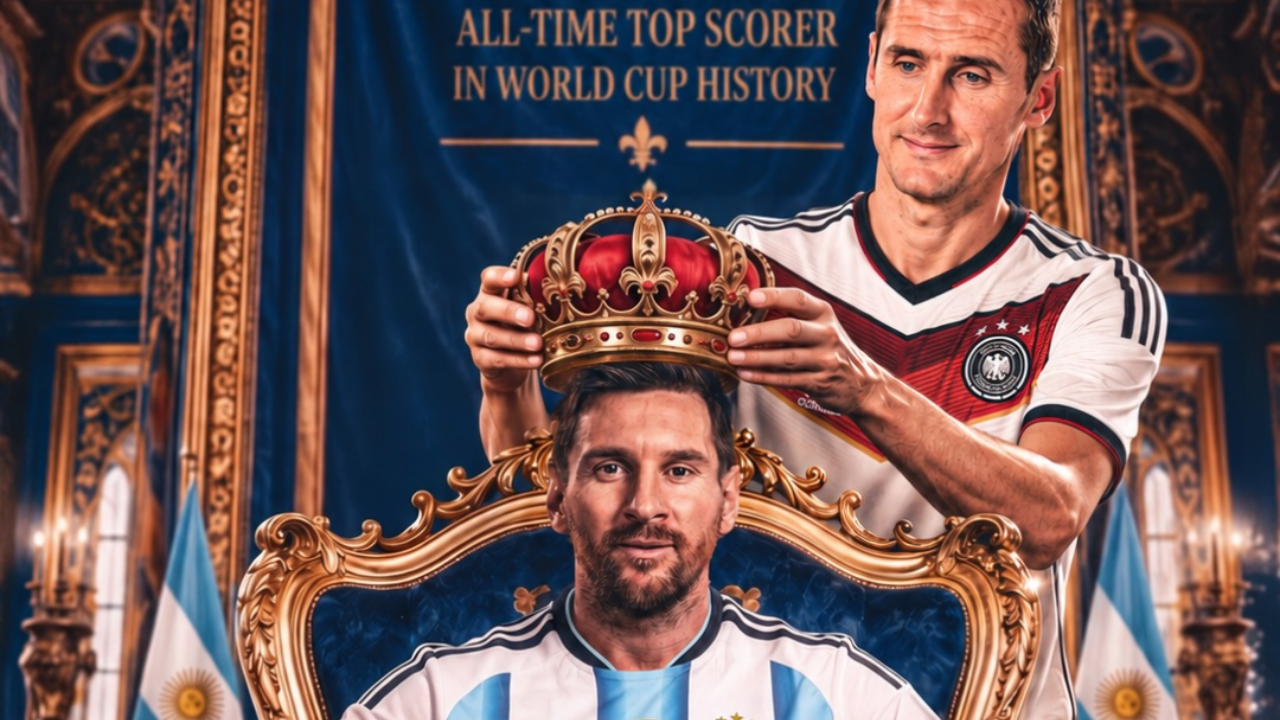
Lionel Messi scored his 17th and 18th World Cup goals to break Miroslav Klose’s all-time record as Argentina beat Austria 2-0 in Dallas. Full match report, goal details, reaction and what it means for football history
FIFA World Cup 2026 | Group J | Dallas Stadium (AT&T Stadium), Arlington, Texas
Argentina 2–0 Austria
Goals: L. Messi 38′, 90+5′
Published: June 22, 2026 | Author: Hemim SK
He missed a penalty first. He always makes you wait.
Nine minutes in, Lautaro Martínez won a spot kick after being pulled back in the box. The moment Messi placed the ball on the spot, 80,000 people inside Dallas Stadium held their breath, because they all understood exactly what goal number 17 would mean. He stuttered in his run-up. The ball went wide right. Silence.
Twenty-nine minutes later, Messi received a low pass at the edge of the box, shifted his weight onto his left foot, and swept the ball into the bottom-left corner. Dallas Stadium exploded.
Goal number 17. The record. All to himself. The greatest scorer in men’s World Cup history.
And then Lionel Messi, at 38 years old, two days before his birthday, with an ailing father undergoing medical treatment back home in Argentina — broke down in tears.
“My tears after the first goal? I’ve had some tough days. It wasn’t related to soccer,” Messi admitted afterward. “Those feelings were because of that. I thank my teammates, the coaching staff and the delegation for helping me.”
He then scored a second one in stoppage time, because that’s what Messi does when the story is already complete — he adds another chapter.
The Wait, The Penalty, The Record
Argentina had every reason to be nervous heading into this match against Ralf Rangnick’s Austria. Their opener against Algeria — a 3-0 win featuring a Messi hat-trick — had already pulled him level with Klose on 16 goals, and the mathematics of the record were all anyone in the footballing world could talk about.
What nobody planned for was a missed penalty. And what nobody expected was that missing it would make the actual record-breaking moment feel even more cinematic.
After the spot-kick went wide, Austria grew into the match. Rangnick’s side, built around Marcel Sabitzer’s craft and a compact pressing system, made Argentina genuinely uncomfortable for long stretches of the first half. Emiliano “Dibu” Martínez made several crucial interventions, and for all Argentina’s possession, the clear-cut chances were scarce.
Then came the 38th minute. Thiago Almada let Facundo Medina’s pass go through to Messi’s left foot at the top of the box. One touch. One look. One swing. Bottom-left corner. 1-0.
Argentina’s Lionel Messi made the record goal, his 17th, during the first half of Monday’s game against Austria.
The scenes that followed were unlike anything seen at a World Cup in years. Messi’s teammates engulfed him before he could even reach the corner flag, Lautaro first, then Enzo Fernández, then the entire squad pouring off the bench. Messi stood in the middle of it all, head in hands, tears rolling down his face, the weight of two decades of World Cup history resting visibly on his shoulders.
The Second Goal — Because 17 Was Never Going to Be Enough (90+5′)
With Argentina 1-0 up and Austria pressing for an equalizer in the final minutes, the match felt unresolved, tense. Then, deep into stoppage time, Messi pushed through the Austrian backline inside the box, saw Schlager turn away his first effort, and slotted home the rebound.
He followed that with his 18th goal to seal a 2-0 victory against Austria and take his 2026 tournament tally to five. He now holds the outright scoring record, as well as extending the record for most FIFA World Cup appearances in his 28th match.
18 goals. Five at this tournament alone. Argentina 2-0 Austria. Done.
What the Numbers Actually Mean
The scale of what Messi has achieved across six World Cups deserves to be laid out clearly, because the numbers are almost incomprehensible:
| Rank | Player | Country | Goals |
|---|---|---|---|
| 1 🔥 | Lionel Messi | Argentina | 18 |
| 2 | Miroslav Klose | Germany | 16 |
| 3 | Ronaldo (R9) | Brazil | 15 |
| 4 | Kylian Mbappé | France | 14 |
| 5 | Gerd Müller | Germany | 14 |
With 18 World Cup goals, 201 international caps and a record sixth World Cup appearance, Messi continues to deliver no matter the obstacles — he also becomes the first men’s player ever to reach 18 goals at the global football tournament.
By scoring his 18th goal, he surpassed Brazilian great Marta, who has 17 goals in FIFA Women’s World Cups, to become the greatest World Cup goalscorer, male or female.
His journey to this moment stretches back exactly 20 years. Messi scored his first World Cup goal on June 16, 2006, at 18 years old, netting a second-half strike against Serbia and Montenegro in Germany. Twenty years later, almost to the day, he opened the 2026 tournament with a hat-trick against Algeria.
The Personal Backdrop That Made This Moment Different
Records at World Cups usually come wrapped in pure football storylines. This one arrived carrying something heavier.
The goal comes amid a tough week for Messi and his family. Jorge Messi was set to undergo medical treatment for an undisclosed illness last week. Messi’s family asked for “humanity” from the media.
His tears after the record-breaking goal were not tears of football joy. He said so himself. They were something deeper — the release of a man carrying more than a football match on his shoulders, surrounded by teammates who clearly understood that and made sure he didn’t carry it alone.
“Beyond anything I’m so happy for the win,” Messi said. “It was huge, tough and difficult. It would allow us to be relaxed to what’s ahead. All matches in this World Cup are very even, very intense. I’m enjoying this moment and craving to enjoy with my teammates.”
The Race Is Still On — And It’s Coming From France
The record may not stay unchallenged for long. Kylian Mbappé, who scored twice in France’s opening win over Senegal, now sits on 14 World Cup goals at 27 years old — almost certainly with at least one more World Cup ahead of him.
As for how long Messi could hold this record, it will depend on the form of Kylian Mbappé, who entered this tournament with 14 goals. The Frenchman already scored twice in the opening win against Senegal, and at age 27, is likely to have at least one more World Cup after this one.
But for tonight, in Dallas, none of that matters. Tonight belongs entirely to Messi, to Argentina, and to a record that waited 20 years and six World Cups to arrive.
Group J Standings After Matchday 2
| Team | P | Pts | |
|---|---|---|---|
| 1 | Argentina 🇦🇷 | 2 | 6 |
| 2 | Algeria 🇩🇿 | 1 | 3 |
| 3 | Austria 🇦🇹 | 2 | 0 |
| 4 | Jordan 🇯🇴 | 1 | 0 |
Argentina are through to the knockout rounds. Messi gets his birthday — June 24 — knowing the record is already his.
Need To Know
Q: How many World Cup goals does Messi have?
A: 18 — the most by any player in the history of the FIFA World Cup, men or women.
Q: Who did Messi break the record from?
A: Miroslav Klose of Germany, who previously held the men’s record with 16 World Cup goals scored across four tournaments (2002-2014).
Q: What was the score in Argentina vs Austria?
A: Argentina 2-0 Austria. Both goals were scored by Lionel Messi — his 17th and 18th World Cup goals.
Q: Where was the match played?
A: Dallas Stadium (AT&T Stadium) in Arlington, Texas.
Q: Did Messi miss a penalty in this match?
A: Yes — he put a spot kick wide in the 9th minute before scoring the record-breaking goal in the 38th minute.
Q: Is Messi also the all-time top scorer across men’s and women’s World Cups?
A: Yes. His 18th goal surpassed Marta’s record of 17 in the FIFA Women’s World Cup, making him the greatest scorer across both tournaments.
Q: How many World Cups has Messi appeared in?
A: Six — 2006, 2010, 2014, 2018, 2022 and 2026 — the most by any men’s player in history.
Q: Who is closest to breaking Messi’s record?
A: Kylian Mbappé of France, currently on 14 World Cup goals at age 27, is the most likely candidate to eventually surpass 18.