
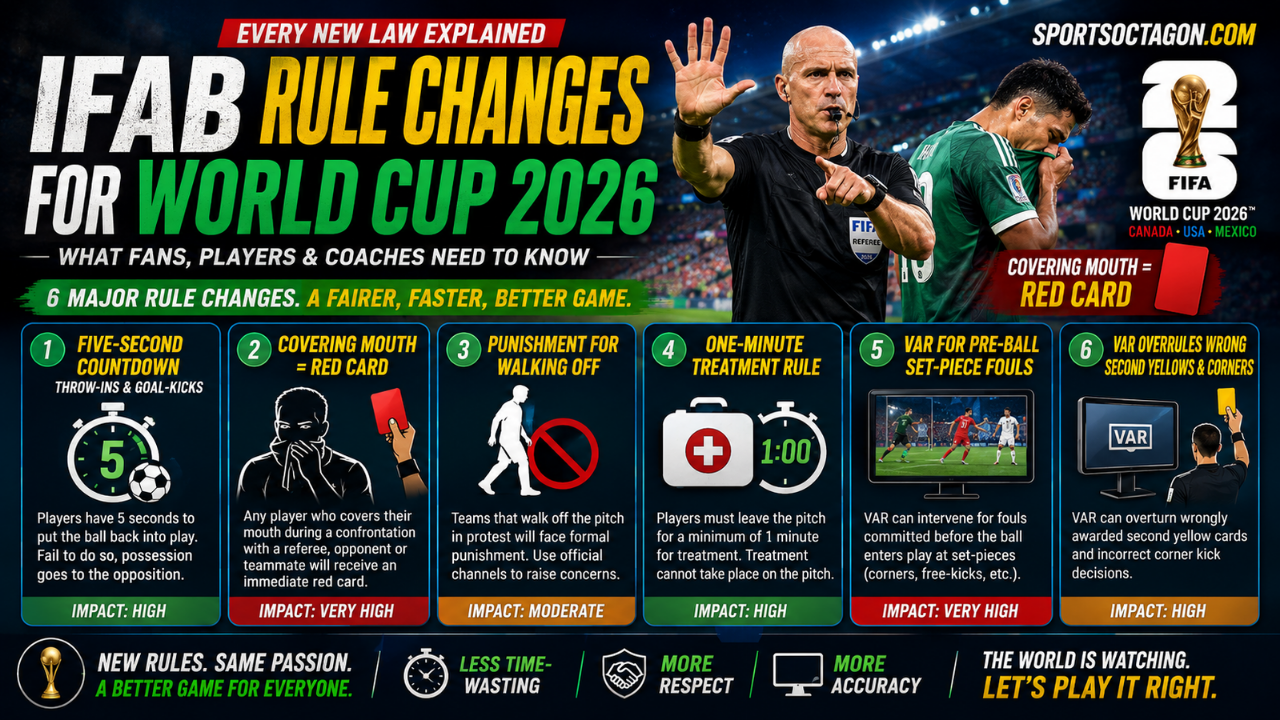
IFAB have confirmed major rule changes for FIFA World Cup 2026. From five-second countdowns on throw-ins to red cards for covering mouths, here is every new law explained and what it means for the tournament.
Published: June 1, 2026 | FIFA World Cup 2026 | SportsOctagon Desk
The FIFA World Cup 2026 is not just bringing the biggest tournament in football history to North America — it is also bringing the most significant set of rule changes the game has seen in years.
The International Football Association Board (IFAB) — the body responsible for the laws of football — has confirmed a series of new rules that will be enforced at the 2026 World Cup. Some of these changes will affect how matches flow. Others will change how players behave during confrontations. And the expanded VAR powers could have a dramatic impact on the outcome of knockout matches.
Whether you are a fan watching from the stands, a player preparing to compete, or simply someone trying to understand what is different about the 2026 tournament — this is everything you need to know.
Here is the complete breakdown of every IFAB rule change for World Cup 2026, explained clearly and in full.
Every IFAB Rule Change for World Cup 2026 — Full List
⏱️ Rule Change 1: Five-Second Countdowns for Throw-Ins and Goal-Kicks
What is the new rule? Players taking throw-ins and goal-kicks will now have a maximum of five seconds to put the ball back into play once they are ready to do so. If they fail to take the restart within five seconds, the ball is awarded to the opposition.
Why has this been introduced? Time-wasting has been one of the most persistent and frustrating problems in football at the highest level. Teams protecting a lead routinely slow the game down by taking as long as possible over every restart — particularly throw-ins, which happen dozens of times per match. The five-second countdown rule is IFAB’s most direct attempt yet to tackle this issue and keep matches flowing.
What does it mean in practice? Expect referees to count down visibly — possibly using hand signals — and be prepared for a significant number of possession changes early in the tournament as players and teams adapt to the new timing. Teams that rely heavily on slow build-up from restarts will need to adjust their approach significantly.
Impact Level: HIGH — This will change the rhythm of matches noticeably.
🟥 Rule Change 2: Red Cards for Players Covering Their Mouths During Confrontations
What is the new rule? Any player who covers their mouth with their hand or shirt during a confrontation with a referee, opponent, or teammate will receive a red card. The rule is specifically targeting players who attempt to hide what they are saying during heated exchanges — typically abuse, threats, or discriminatory language directed at officials.
Why has this been introduced? Football has a long-standing problem with players abusing referees while concealing their words behind their hands or shirt collars to avoid lip-reading cameras. IFAB introduced this rule to give referees the authority to punish behaviour that undermines respect for officials, even when the exact words cannot be heard.
What does it mean in practice? This is one of the most controversial rule changes in the package and will almost certainly produce a high-profile red card in the early stages of the tournament. Players who are accustomed to whispering complaints to referees while covering their mouths will need to change their habits immediately. Any player caught doing so faces instant dismissal — no warning, no yellow card first.
Impact Level: VERY HIGH — Expect controversy and adjustment throughout the tournament.
🚶 Rule Change 3: Punishments for Teams Walking Off the Pitch in Protest
What is the new rule? Any team that walks off the pitch as a form of protest — against a refereeing decision, an incident of racism, or any other reason — will face formal punishment under the new rules. Teams are expected to remain on the pitch and use official channels to raise concerns.
Why has this been introduced? In recent years, teams at various levels of football have walked off the pitch to protest racist incidents in the crowd. While IFAB and FIFA support the fight against discrimination, the governing bodies want to establish a formal protocol that does not disrupt matches or set a precedent for walk-offs over refereeing decisions.
What does it mean in practice? This rule is likely to be tested at some point during the tournament, given the global nature of the event and the diverse fan bases attending. Teams will be advised to follow the official FIFA anti-racism protocol — which involves reporting to the referee and fourth official — rather than taking unilateral action.
Impact Level: MODERATE — Unlikely to affect most matches but significant when it applies.
🏥 Rule Change 4: Mandatory One-Minute Off-Field Treatment Periods
What is the new rule? When a player requires medical treatment during a match, they must now leave the field of play for a mandatory minimum of one minute before being allowed to return. The treatment must take place off the pitch — not on it.
Why has this been introduced? This rule directly targets the widespread practice of players exaggerating injuries to waste time, receive treatment on the pitch, and then immediately return to play without any real interruption to the match. The mandatory one-minute off-field period ensures that any player who genuinely needs treatment receives it properly, while simultaneously removing the incentive to fake injuries for time-wasting purposes.
What does it mean in practice? Teams will no longer be able to use feigned injuries as a tactical tool to waste time or break up opposition momentum. If a player goes down and requires the medical team to come onto the pitch, they must go off for at least one minute. This will require tactical adjustments — particularly late in matches when teams are defending a lead.
Impact Level: HIGH — This fundamentally changes the injury time-wasting dynamic in football.
📹 Rule Change 5: VAR Can Intervene for Fouls Committed Before the Ball Enters Play at Set-Pieces
What is the new rule? VAR officials will now have the power to step in and overturn or flag incidents where a foul is committed before the ball enters play at a set-piece situation — such as a corner kick or free-kick. Previously, VAR could only review incidents that occurred after the ball was in play.
Why has this been introduced? Players have long exploited the moment just before a set-piece is taken — particularly at corners — to foul, block, or illegally impede opponents before the ball is in play, knowing that VAR could not act. This loophole has been used systematically at the highest level to neutralise opponents’ set-piece routines.
What does it mean in practice? Set-piece specialists and teams that rely heavily on organised corner kick routines will need to reassess their approach entirely. If players are illegally blocking or fouling before the ball is delivered, VAR can now act. This is a significant change that could directly affect goals — particularly in a World Cup where set-pieces often decide knockout matches.
Impact Level: VERY HIGH — This could directly influence results in knockout matches.
📹 Rule Change 6: VAR Can Overturn Wrongly Awarded Second Yellow Cards and Corner Kicks
What is the new rule? VAR will now have the authority to review and overturn wrongly awarded second yellow cards and incorrectly given corner kicks. Both of these can now be corrected by the video review system if the on-field decision is clearly wrong.
Why has this been introduced? Second yellow cards leading to red cards are among the most match-defining moments in any football tournament. Wrongly awarding one — through a mistaken identity or a failure to see a clear simulation — could unfairly change the outcome of a World Cup match. Giving VAR the power to correct these decisions ensures the most serious disciplinary errors can be addressed.
Corner kick decisions, while seemingly minor, can also be significant — particularly in tight knockout matches where set-pieces are one of the primary routes to goal.
What does it mean in practice? Referees will know their second yellow card decisions are subject to VAR review, which should make them more careful before showing the card. For players, it means the safety net of an incorrect second yellow reducing their team to ten men is removed. Correct decisions will be enforced.
Impact Level: HIGH — Every second yellow card in knockout rounds will carry extra scrutiny.
Summary: All Six IFAB Rule Changes at a Glance
Rule Change Impact
- Five-second countdown on throw-ins and goal-kicks Reduces time-wasting, changes game rhythm
- Red card for covering mouth during confrontation Protects referees, punishes hidden abuse
- Punishment for walking off pitch in protest Maintains match continuity, formal protest channels required
- Mandatory one-minute off-field treatment Ends fake injury time-wasting tactic
- VAR for pre-ball set-piece fouls Closes long-exploited loophole at corners
- VAR overturn of wrong second yellows and corners. Improves accuracy of key disciplinary decisions
What These Rule Changes Mean for World Cup 2026
Taken together, these six rule changes represent the most comprehensive attempt to clean up football’s most persistent problems in a generation. Time-wasting, referee abuse, fake injuries, and set-piece exploitation have undermined the sport at its highest level for decades.
IFAB is sending a clear message with the 2026 World Cup as the stage: the game is changing, the tolerance for gamesmanship is shrinking, and the players and teams who adapt fastest will have a significant advantage.
For fans, these changes should produce a faster, more flowing, and more honestly contested tournament. For players, the message is simple — play the game, respect the officials, and stop the theatrics.
The 2026 World Cup will be the most watched sporting event in history. IFAB wants to make sure the football itself is worthy of that audience.
Sports Octagon — Further World Cup 2026 Reading
For the full story on every team heading to North America, read our complete World Cup 2026 squad breakdowns including Argentina’s squad, Spain’s squad, Morocco’s squad, and our World Cup 2026 Top Scorers History — all at sportsoctagon.com.
Frequently Asked Questions — IFAB Rule Changes World Cup 2026
Q: What are the new IFAB rule changes for World Cup 2026?
IFAB has introduced six major rule changes for World Cup 2026: five-second countdowns for throw-ins and goal-kicks; red cards for covering mouths during confrontations; punishments for walking off in protest; mandatory one-minute off-field treatment; VAR intervention for pre-ball set-piece fouls; and VAR power to overturn wrong second yellow cards and corner kick decisions.
Q: What happens if a player covers their mouth at World Cup 2026?
Under the new IFAB rules for World Cup 2026, any player who covers their mouth during a confrontation with a referee, opponent or teammate will receive an immediate red card. There is no warning — it is a straight dismissal.
Q: What is the five-second rule at World Cup 2026?
The five-second rule means players taking throw-ins and goal-kicks must put the ball back into play within five seconds of being ready to do so. If they fail to do so, possession is awarded to the opposing team. It is designed to reduce time-wasting at restarts.
Q: Can VAR overturn a red card at World Cup 2026?
Yes. Under new IFAB rules, VAR can now review and overturn wrongly awarded second yellow cards — which result in red cards — if the original decision was clearly incorrect. This applies to cases of mistaken identity or a clear simulation by the player who won the foul.
Q: What is the one-minute treatment rule at World Cup 2026?
Under the new rules, any player who receives treatment from the medical team during a match must leave the field of play for a mandatory minimum of one minute before returning. Treatment cannot take place on the pitch. This rule is designed to stop players faking injuries to waste time.
Q: Who is IFAB and why do they make football rules?
IFAB — the International Football Association Board — is the body responsible for writing and maintaining the laws of association football. It was founded in 1886 and consists of FIFA and the four British football associations (England, Scotland, Wales, and Northern Ireland). All changes to the laws of football must be approved by IFAB.
Q: Will the five-second countdown apply to every restart at World Cup 2026? The five-second countdown specifically applies to throw-ins and goal-kicks at World Cup 2026. It does not apply to free-kicks or corner kicks, which have their own existing restart procedures.