
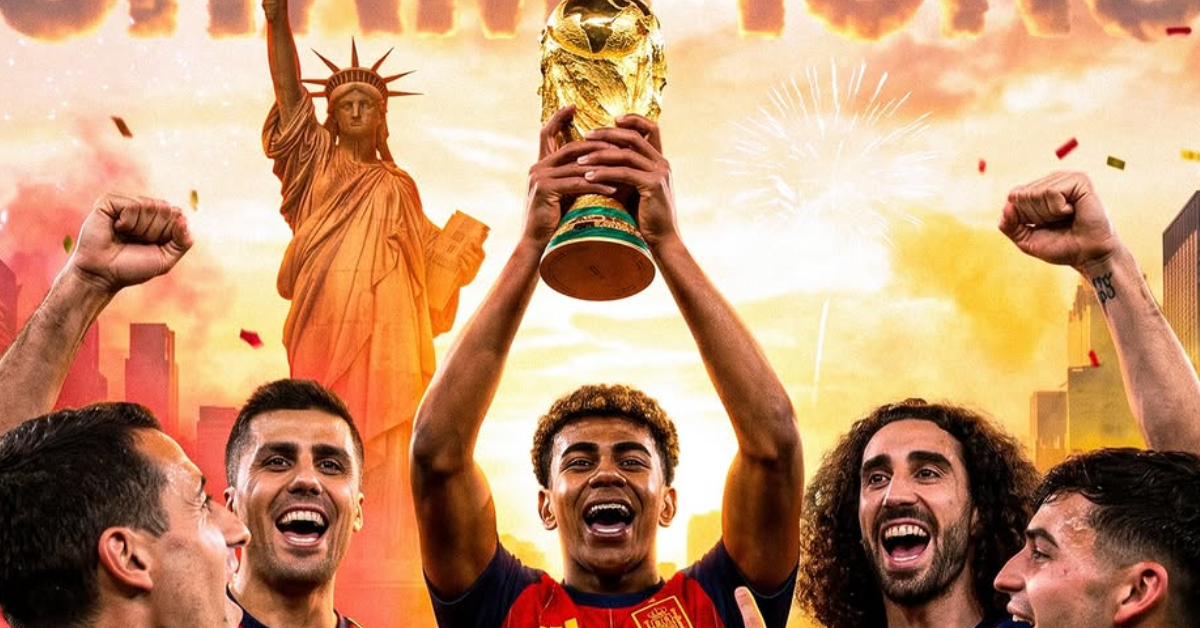
Spain beat Argentina 1-0 after extra time in the World Cup 2026 Final at MetLife Stadium. Ferran Torres scored in the 106th minute. Spain had 20 shots, Argentina had 2. Spain had 803 passes, Argentina had 445. Enzo Fernandez was sent off. The numbers tell a story the scoreline barely begins to capture.
Published: July 20, 2026 | Category: FIFA World Cup 2026 | Author: Hemim SK
Let us begin with the numbers. Because the numbers from the World Cup 2026 Final are the most extraordinary set of match statistics produced by any team in any World Cup Final since Opta records began. And they tell you almost everything about what happened at MetLife Stadium in New Jersey on Sunday July 19, 2026 — and almost nothing about why it took until the 106th minute to decide it.
Spain 20 shots. Argentina 2.
Spain 11 shots on target. Argentina 0.
Spain 68% possession. Argentina 32%.
Spain 803 passes at 90% accuracy. Argentina 445 at 78%.
Spain 9 corners. Argentina 4.
Spain 0 yellow cards. Argentina 5 yellow cards and 1 red card.
Spain 21 fouls. Argentina 24 fouls.
Spain 4 offsides. Argentina 1.
And the final score: Spain 1-0 Argentina after extra time.
Ferran Torres. 106th minute.
Spain are the World Cup 2026 champions.
PART ONE: WHAT THE NUMBERS SAY
Twenty shots to two. That ratio — ten times more attempts than their opponents in a World Cup Final — is not simply a dominant performance. It is the most one-sided shot count in the history of the World Cup Final going back to the first tournament data available. Germany had more shots than Argentina in the 2014 final at the Maracanã. France had more than Croatia in 2018. But not twenty to two. Not eleven on target to zero.
Eleven shots on target from Spain. Zero from Argentina.
Argentina — the defending champions, the team of Messi, of Lautaro Martinez, of Enzo Fernandez — did not produce a single shot on target across 120 minutes of the World Cup Final against Spain. Not in normal time. Not in extra time. Zero. Emiliano Martinez, Argentina’s goalkeeper — considered the best penalty stopper in the tournament and one of the best in the world — was never truly tested. He had no shots on target to stop.
The 803 passes. Spain completed 803 passes at 90% accuracy in a World Cup Final. The previous record for pass completions in a World Cup Final was set by Spain themselves in their 2010 victory over the Netherlands — 579 passes. They eclipsed their own record by 224 passes and still only won 1-0.
This is not a criticism of Spain. It is a description of what happens when the most technically gifted possession-based team in European football meets the most tactically disciplined defensive team in South American football at the peak of both nations’ organisational intelligence.
PART TWO: WHAT THE NUMBERS CANNOT SAY
Here is what the numbers cannot tell you. They cannot tell you what it felt like inside MetLife Stadium when Lamine Yamal — 18 years old, born on the day Ronaldo cried at Euro 2004, the player who assisted the goal that ended Ronaldo’s final World Cup — collected the ball for the first time in the first minute of the final and drove at Argentina’s defensive line and 82,000 people held their breath simultaneously.
They cannot tell you what Messi looked like during the eight minutes he spent on the pitch in the second half of extra time, introduced as a substitute — at 38 years old, with eight tournament goals and the Golden Boot lead and nothing more to prove to anyone — trying one final time to be the player who won Argentina the final they were not supposed to win. He did not score. He touched the ball twice. He walked off at full time and the camera found his face and whatever was on it was not for us to interpret.
They cannot tell you what Rodri’s face looked like when Ferran Torres scored in the 106th minute — the midfielder who had been the best player in the tournament across six weeks of knockout football, who had neutralised Mbappé in the semi-final and neutralised Messi in the final and produced the kind of sustained defensive excellence that wins championships invisibly.
The numbers can tell you Spain were dominant. They cannot tell you how it felt to watch Argentina — a team that had no shots on target in a World Cup Final — make Spain fight for every one of those 803 passes, every one of those 20 shots, for 106 minutes before the goal that ended it finally came.
PART THREE: FERRAN TORRES IN THE 106TH MINUTE
Ferran Torres had scored twice in Spain’s group stage campaign — an efficient, clinical contributor to a squad built around Yamal’s creativity and Rodri’s control rather than his own individual stardom. He was not the name anyone predicted as the World Cup 2026 Final goalscorer. He was not the obvious choice, not the instinctive answer to the question of who scores the goal that wins a World Cup.
But football does not ask permission before writing its most important moments. And in the 106th minute of extra time — with the match still level at 0-0, with Argentina’s ten remaining outfield players (Enzo Fernandez had been sent off in the 90+3rd minute, a moment that seemed to demand the goal would follow and then somehow did not for another sixteen minutes) protecting a goalless draw with the specific grim efficiency of a team that knows exactly how to survive — Ferran Torres was in the right place.
Yamal drove at the left side of Argentina’s penalty area — the same run, from the same position, that he had made twenty times across the previous 105 minutes without finding the final outcome. This time, the ball fell to Torres arriving at the back post.
He did not hesitate. Right foot. Low. Across Emiliano Martinez.
The net moved.
106th minute. Spain 1-0 Argentina. Ferran Torres. The World Cup Final goal that nobody predicted, scored by the player nobody had highlighted, in the minute that arrived 105 minutes after it should have.
MetLife Stadium — the same venue that had hosted Brazil vs Morocco in the group stage, that had been promised as the final destination since the tournament began, that had been pointed at by every team still standing as the endpoint of their ambition — became the loudest place in the world for exactly twelve seconds before the sound transformed from anticipation into release.
PART FOUR: ENZO FERNANDEZ AND THE RED CARD AT 90+3
The Enzo Fernandez dismissal in the 90th minute plus three deserves its own honest assessment.
Fernandez — who had scored the goal against England in the semi-final that started Argentina’s comeback, who had been their most important creative midfielder across the entire tournament — received a second yellow card for a foul on Baena in the 90+3rd minute of normal time. Argentina, already clinging to 0-0 by the extraordinary defensive discipline of a team with zero shots on target, were reduced to ten men.
The logic of what should follow seemed inevitable. Ten men. Extra time. Spain with 20 shots and 803 passes and the best attacking unit at the tournament. Spain would score within the first fifteen minutes of extra time.
They did not score for another sixteen minutes. Ten-man Argentina held Spain scoreless for sixteen minutes of extra time with no shots, no possession, and 24 total fouls — because that is what this Argentina do. That is what Scaloni has built. Not a team that wins with football but a team that survives with everything it has, holds the line until the moment of fortune or individual brilliance that tips the balance, and then — when it finally goes against them — stands in the specific dignity of a team that gave every last atom of resistance before accepting the outcome.
Argentina with ten men, in extra time, no shots on target, held Spain for sixteen minutes. It is absurd. It is also extraordinary.
PART FIVE: YAMAL, RODRI AND WHAT SPAIN HAVE BUILT
Spain won the World Cup 2026 with a team that is, by average age, the youngest side to lift the trophy since West Germany in 1954. Lamine Yamal at 18. Pau Cubarsí at 17 — the youngest player to appear in a World Cup Final in the modern era. Gavi not even in this squad because he was injured for the season. Pedri available from the bench.
This is a Spanish golden generation that is at the very beginning of what it can become. The 2026 title is the opening chapter, not the peak.
Rodri, across the entire tournament, was the best player at World Cup 2026 by the measure that matters most — the measure of how much worse the team would have been without him. Neutralised Mbappé in the semi-final. Neutralised Messi in the final. Completed more passes in the knockout stage than any other player. Won every defensive duel that mattered when it mattered.
Yamal, for all the records and the stories and the symbolism — born on Ronaldo’s first heartbreak day, assisting Ronaldo’s last World Cup elimination goal — was the creative force that made Spain’s dominance possible. Nineteen shots would not have happened without him. The defensive lines that broke under pressure to give Torres his moment in the 106th would not have broken without Yamal having driven at them 104 times before.
Spain are World Champions. They deserve to be.
PART SIX: MESSI AND THE GOLDEN BOOT
Messi did not score in the final. Mbappé’s ten goals — scored in France’s run to the semi-final and third place, with two against England on the final day — give him the Golden Boot at a tournament France did not win and where he was eliminated in the semi-final.
That specific irony — the tournament’s top scorer walking away with the individual award while his team finished fourth — is one of football’s recurring cruelties and one of its most specific pleasures simultaneously. Mbappé scored ten goals and France are fourth. Messi scored eight goals and Argentina are second. The Golden Boot went to the player who scored more goals. The World Cup went to neither of them.
Spain won. Ferran Torres scored the goal. In the 106th minute. Against a team with zero shots on target.
The numbers were correct about who was better. They were not correct about how easy it would be.
Both things, as we noted at the start, are completely true.
THE WORLD CUP 2026 — FINAL FACTS
World Cup 2026 Champions: Spain
Runners-Up: Argentina
Third Place: England
Fourth Place: France
Golden Boot: Kylian Mbappé (France) — 10 goals
World Cup Final MVP: Rodri (Spain)
Tournament’s Top Saves: Vozinha (Cape Verde) — nine saves vs Argentina
Most Memorable Goal: Ferran Torres, 106th minute, World Cup Final
Most Memorable Story: Vozinha — 14 million Instagram followers, mother who couldn’t afford the visa, nine saves against the defending champions
Tournament host: USA, Canada, Mexico
World Cup Final venue: MetLife Stadium, East Rutherford, New Jersey
Attendance: 80,663
Final score: Spain 1-0 Argentina (after extra time)
Goal: Ferran Torres 106′
Red card: Enzo Fernandez (Argentina) 90+3′
Need To Know
Who won the World Cup 2026?
Spain won the FIFA World Cup 2026, beating Argentina 1-0 after extra time in the final at MetLife Stadium in New Jersey on July 19, 2026.
Who scored the World Cup 2026 Final winning goal?
Ferran Torres scored Spain’s winning goal in the 106th minute of extra time — the decisive moment in a match Spain dominated completely by every statistical measure.
How many shots did Argentina have in the World Cup 2026 Final?
Argentina had only 2 shots in the entire World Cup 2026 Final — with zero on target across 120 minutes. Spain had 20 shots and 11 on target.
Who won the Golden Boot at World Cup 2026?
Kylian Mbappé won the Golden Boot at World Cup 2026 with 10 goals — scored for France across their run to the semi-final and third place. Lionel Messi finished on 8 goals.
Was Messi sent off in the World Cup 2026 Final?
No — Enzo Fernandez was sent off with a red card in the 90+3rd minute of normal time. Messi came on as a substitute in extra time but did not score.
Why did Enzo Fernandez get a red card in the World Cup Final?
Enzo Fernandez received a second yellow card — and therefore a red card — for a foul on Álvaro Baena in the 90+3rd minute of the World Cup 2026 Final, reducing Argentina to ten men for the entirety of extra time.
How many passes did Spain complete in the World Cup 2026 Final?
Spain completed 803 passes at 90% accuracy in the World Cup 2026 Final — a new record for pass completions in any World Cup Final, surpassing their own previous record set in the 2010 final against the Netherlands.
Is Lamine Yamal a World Cup champion at 18?
Yes — Lamine Yamal became a World Cup champion at 18 years old, making him one of the youngest World Cup winners in football history and the youngest member of Spain’s title-winning squad.
Conclusion
Spain 1-0 Argentina. After extra time. 106 minutes. Ferran Torres.
Twenty shots to two. Eleven on target to zero. Eight hundred and three passes. One red card for Argentina. Zero shots on target for the defending champions. One goal, in the 106th minute, from the player nobody predicted.
The numbers say Spain were dominant. The scoreline says they won by the smallest possible margin. The tournament says that 32 teams came to the United States, Canada and Mexico, and the one that leaves with the trophy is the youngest, most technically gifted, most possession-complete side in the world.
Spain are World Champions. Lamine Yamal is 18 years old and has a World Cup winner’s medal. Rodri was the best player at the tournament. Ferran Torres scored the goal that nobody saw coming in the minute that arrived later than everyone expected.
And somewhere in this tournament’s 39 days — from Mexico vs South Africa at the Azteca to this final at MetLife, from Vozinha’s nine saves against Messi to Messi’s eight goals that were not quite enough, from Mbappé’s ten goals to Bellingham’s 90+8th in Miami — something extraordinary happened.
The first 48-team World Cup was played. And it was magnificent.
Read next: World Cup 2026 Best XI — The Team of the Tournament
Related: Spain World Cup 2026 Schedule — La Roja’s Complete Journey to the Title
Related: Argentina World Cup 2026 Schedule — The Path to the Final
Related: World Cup 2026 — Every Result, Every Goal, Every Story
Is Spain 2026 the greatest World Cup winning team of the 21st century — and where does Yamal’s World Cup rank in the greatest individual tournament performances ever? Tell us in the comments below